
Blood of the Leopard (BoL) – Living Intelligence Assessement and Blood of the Leopard (BoL) – Overview and Links to Sections.
Global Demand — Multiple Markets, One Animal
The leopard’s vulnerability is the breadth of what it is worth dead. Over 60,000 recorded commodities, meaning leopard body parts this century, is the deadly testament to that vulnerability.
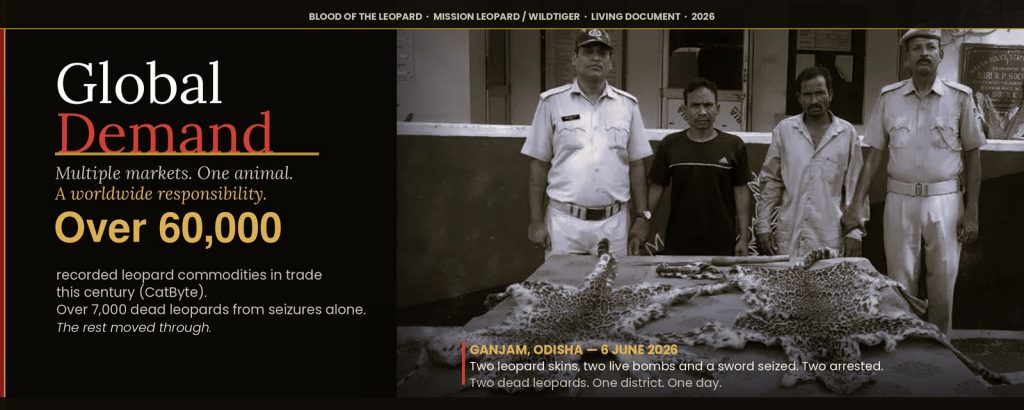
Between 2000 and July 2024, reported incidents point to at least 6,829 leopards detected in the illegal trade (EIA and WPSI, 2024). Source: CatByte. Since that figure was published, continued seizure monitoring — drawing on Wildlife Protection Society of India (WPSI) data alone — has pushed the documented total past 7,000 leopards. This information is based strictly on documented seizure data. As detailed throughout Blood of the Leopard, various multipliers must be applied to estimate the true number of leopards slaughtered. The actual numbers can never be fully known, but it is mathematically certain that tens of thousands more leopards are killed than the baseline indicator figures show.
The Demand Problem
Most illegal wildlife trade policy focuses heavily on the supply side — the poachers, the rural networks, the seizure points, and enforcement failures. While supply-side intervention is an integral part of reducing the trade, it is insufficient if not combined with demand reduction.
The leopard parts trade persists because there is a relentless demand across multiple product categories, multiple cultures, and multiple geographies simultaneously. Until demand is structurally dismantled with the same tactical seriousness as supply, the underlying economics will continue to favour the criminal syndicates.
Data from the Environmental Investigation Agency (EIA) Global Environmental Crime Tracker shows that at least 6,000 whole leopards, or their equivalents in processed products, have been seized since the year 2000 in Asia alone. Combined with comprehensive localised datasets from India (and continuing invetigations in other areas of the leopard’s global tange) , the documented minimum has now passed 7,000 leopards — and because law enforcement intercepts only a fraction of the total illicit volume, this metric represents just the tip of a catastrophic iceberg.
The Two Scales of the Trade
It is important to distinguish between two different measures, because they describe the trade at two different magnitudes — and both are real.
The first is the seizure record: the documented minimum of leopards intercepted in the illegal trade. That figure — over 7,000 since 2000 — counts only what enforcement caught.
The second is the total recorded trade in leopard commodities, legal and illegal combined, as tracked by CatByte. Between 2000 and 2023, an estimated 60,830 leopard commodities were recorded in trade. Around 91% of these — 55,583 — originated from wild-sourced leopards. Only 5% came from captive-bred animals. Within that total, derivatives (any processed part) accounted for 32% of all trade, claws for 17% — most sourced illegally and frequently substituted for tiger claws — and skins for 6%, moving mostly through illegal channels.
The gap between these two numbers — 7,000 documented seizures against 60,830 recorded commodities — is the gap between what is caught and what moves. It is also a measure of how much of this trade operates in plain sight, recorded, permitted, and legal, alongside the illegal trade that shadows it.
Underlying both figures is a ratio that EIA’s data make stark: for every tiger killed, three to five leopards are killed. The leopard is not a lesser victim of the big cat trade. By volume, it is the principal one.
Four Leopards a Week: The Scale Quantified
The single most rigorous attempt to measure the true scale of India’s leopard trade remains the landmark TRAFFIC study Illuminating the Blind Spot, published with WWF in 2012. Analysing seizure data across the decade from 2001 to 2010, it documented 420 seizure incidents across 209 localities in 21 of India’s territories — accounting for at least 1,127 leopards in reported seizures alone, a recorded rate of 2.2 leopards every week.
But reported seizures capture only the detected fraction of the trade. Applying mark-recapture statistical modelling — a method used in ecology to estimate population size from incomplete data — the study estimated the true total at 2,294 leopards poached and in illegal trade over the decade. That is the origin of the figure that has defined this crisis ever since: at least four leopards entering India’s illegal trade every week, for ten years. The authors stressed that this more than doubled all previously reported statistics, and even then was conservatively presented as an improved lower limit.
The study also revealed a chilling rhythm to the trade. Across the decade, the mean gap between two successive seizures was just 8.6 days — and 56% of seizures were separated by five days or less. The killing was not episodic. It was continuous.
More than a decade later, nothing in the seizure record suggests the rate has slowed. The running total documented through 2024 and beyond — now past 7,000 leopards — is the continuation of exactly the pattern TRAFFIC quantified. The four-a-week figure was not a historical spike. It was a baseline that has held.
A Single Week, A Single District: The Scale Made Concrete
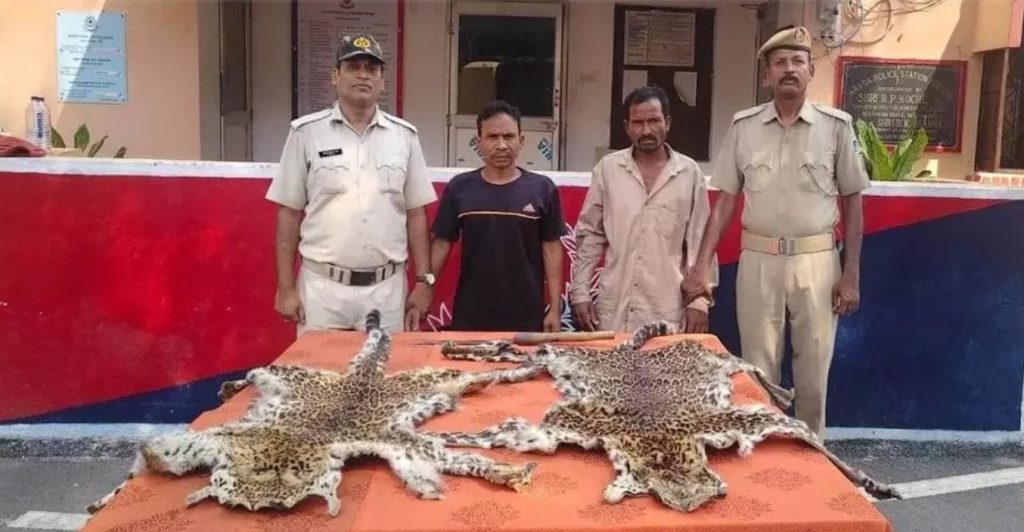
If “four a week” is the statistic, Ganjam is the photograph.
On 6 June 2026, in the upper Buratal area of Ganjam district, Odisha, police acting on intelligence intercepted two men attempting to flee toward forest. After a chase in which one suspect brandished a sword at officers, both were overpowered. In two gunny bags: two full-size leopard skins. On their persons: two live handmade bombs and a sword. The accused — Kesaba Jamadar, 34, and Bira Jamadar, 45 — held no documents authorising possession of the skins, the weapons, or the explosives.
Two leopard skins. Two dead leopards. One district. One day.
This seizure was not an isolated event. It was the third documented leopard skin seizure in Odisha in three weeks — following Berhampur on 16 May (a leopard skin recovered alongside live bombs, a sword, an iron rod, and a knife) and Nabarangpur on 21 May (a six-foot leopard skin, two inter-district smugglers arrested). Two of the three seizures involved explosives recovered alongside the skins.
This is what demand looks like at the point of supply. Not an abstraction. Not a historical pattern. A specific number of specific animals, killed and skinned and moved toward a market, in a single district, in a single month — intercepted only because intelligence happened to reach enforcement in time. For every consignment seized, an unknown multiple moves through undetected. The sheer volume and scale of the trade in leopard body parts is staggering. It is a conservation weak spot. It is a weak spot in the so-called human regard for wildlife.
The demand that drives these killings does not originate in Ganjam. It originates in markets across Asia, Africa, Europe, and the Gulf — markets this section documents. The leopard dies in an Indian forest. The reason it dies is global.
Sources: TRAFFIC/WWF, Illuminating the Blind Spot (2012); OdishaTV (7 June 2026); Deccan Chronicle (8 June 2026); OMM COM News.
1. The Skin Trade: A Worldwide Issue with Fluid Markets
To understand the illegal trade of leopard skins, it is critical to recognise that leopard and tiger pelts are almost exclusively trafficked by the exact same criminal networks using identical transnational supply chains. For the purpose of this analysis, the term “Big Cat” is used deliberately: leopard and tiger skins are the primary commodities, with snow leopard and clouded leopard pelts moving through the same pipelines depending on the regional context.
That the skin is the dominant commodity is not an assertion — it is a documented finding. The TRAFFIC study found that of 420 leopard seizure incidents across India, 371 — fully 88.3% — involved skins alone, with a further 5.5% involving skins alongside other parts such as claws, bones, or skulls. The leopard, in the language of the trade, is most often a pelt. Everything else is secondary.
The Socio-Cultural Vacuum: The Trans-Himalayan Corridor
For decades, the most visually dramatic and historically significant demand for leopard skins originated in Tibet, where the chuba — a traditional long robe — was adorned with Big Cat skin trim along the collar, cuffs, and hem.
While the minimal use of tiger and leopard skins was historically restricted to a tiny fraction of the population in eastern Tibet, it evolved into a highly commercialised fashion statement across the Tibet Autonomous Region, western Sichuan, Qinghai, northwest Yunnan, and southern Gansu provinces.
At colourful summer horse festivals, investigators documented hundreds of skins being worn openly by dancers, horse riders, spectators, and even local officials. Complete, untanned skins were sold in large quantities across retail shops in Lhasa and surrounding transit towns — entirely without regulatory oversight.
The landmark joint exposé by the Environmental Investigation Agency (EIA) and the Wildlife Protection Society of India (WPSI) — most notably EIA’s 2004 report The Tiger Skin Trail — mapped these transnational smuggling networks and proved that the demand was not a localised, ancient ceremonial practice. It was a modern, socio-economic status symbol, supplied by an organised criminal pipeline running from Indian forests, through collection hubs, across the Himalaya into Tibet and China.
The geography of that pipeline is confirmed by the TRAFFIC data. Delhi emerged as the single most important hub of illegal leopard trade in India, accounting for more than 26% of all leopards in reported seizures — a major centre of collection and onward trafficking, precisely the role Sansar Chand operated from his Sadar Bazar base. Northern India as a whole — Delhi, Uttar Pradesh, Uttarakhand, Himachal Pradesh, and Haryana — forms the epicentre of the trade, accounting for 67.8% of all leopards killed, with Uttarakhand a primary source state feeding skins toward the Delhi collection hub and onward to the trans-Himalayan corridor. The EIA/WPSI network mapping and the TRAFFIC spatial analysis describe the same machine from two angles: the source forests, the northern collection hubs, the Himalayan crossing, the Tibetan and Chinese markets.
“If you don’t have a tiger or leopard skin, people look down on you,” one buyer told investigators in 2005. “My sister recently went to a company party where she was the only one who wasn’t wearing one. She went out and bought one right after.”
The 2006 Shift and Market Adaptation
Following these joint exposés by EIA and WPSI, His Holiness the Dalai Lama issued a public appeal in 2006 condemning the use of endangered animal skins. This triggered historic, massive public burnings of chubas and pelts across Tibetan regions, causing an immediate, sharp contraction in retail demand. Skinning the Cat, another joint by EIA and EPSI in June 2006 explains the dynamics up to that point in time. Sub-titled ‘Crime and Politics of the Big Cat trade’, the intricacies and global reach of the trafficking of big cat body parts were made known in comprehensive form for the first time.
However, the trade proved highly fluid. Subsequent investigations — including EIA’s Out in the Cold — revealed that syndicates rapidly adapted to the supply shock. As the open wearing of skins became socially taboo, trafficking shifted away from public apparel and transitioned into supplying whole pelts for luxury home décor, high-end taxidermy, and private collections among wealthy elites in mainland China and international markets.
2. The African Markets: Ceremony, Religion, and the Open Trade
The trans-Himalayan and Chinese corridors are the most documented. But the single largest cultural demand for leopard skins on earth may not be in Asia at all. Southern Africa presented a huge problem for the leopard.
The Shembe Church — The World’s Largest Culturo-Religious Leopard Skin Market
The Nazareth Baptist “Shembe” Church — a syncretic faith blending Christianity and Zulu tradition, with an estimated 4 to 5 million followers across southern Africa — represents the principal culturo-religious use of illegal leopard skins in the world. For the Shembe, leopard skins are essential ceremonial attire, worn as shoulder capes (amambatha) and headbands by church members during gatherings.
The scale is extraordinary. At a single Shembe gathering, witnesses have documented more than 1,200 men wearing leopard skin regalia. One conservationist who attended multiple gatherings estimated the numbers not in the dozens or hundreds but in the thousands of skins. Trade in skins is conducted openly at these gatherings, where enforcement is absent — presumably because of the political sensitivities linked to policing traditional and religious practices.
Critically, this demand has shifted leopard killing from incidental to targeted. As one Phinda Game Reserve conservationist documented: poachers are now putting out poisons specifically to target leopards, because the demand for skins is so high. What was once bycatch from the bushmeat trade has become deliberate, demand-driven slaughter. Historically, leopard skin regalia was reserved for Zulu royalty and chiefs — King Goodwill Zwelithini and high-profile figures including former President Jacob Zuma have worn them — and required permits under South African law and CITES Appendix I. But as affluence grew and the custom spread to the broader Shembe membership, demand expanded far beyond what any permit system controlled.
A Conservation Response That Works
The Shembe dimension also contains one of the most encouraging demand-reduction stories in leopard conservation. Panthera’s “Furs for Life” programme produced high-quality synthetic leopard skin capes — amambatha — and distributed them to Shembe followers as an alternative to the real thing. More than 18,500 faux capes have been distributed at gatherings across South Africa. A longitudinal study of 8,600 Shembe followers found measurable acceptance of the faux alternatives — a rare example of a culturally respectful intervention reducing demand for a protected species without confrontation. Panthera’s leopard programme director called it a resolution “simple and respectful of cultural and religious traditions” that was swiftly accepted by local communities.
The lesson is significant for the entire demand argument: demand can be reduced when interventions respect the cultural context that drives it. The Tibetan chuba burnings of 2006 and the Shembe faux-cape programme are the two clearest proofs that cultural demand is not immovable.
The West and Central African Bushmeat-to-Parts Pipeline
Beyond southern Africa’s ceremonial market, West and Central Africa sustain a separate and growing trade. Leopard parts — skins, claws, teeth, bones — serve local traditional medicine and ritual demand, and feed an export market connecting into the global network. A 2025 market survey in Côte d’Ivoire found leopard parts openly for sale in nearly half of 46 markets surveyed. The EAGLE Network seizes approximately 30 leopard skins annually across West, Central, and East Africa, with founder Ofir Drori stating the figure represents a fraction of actual trade and is increasing year on year.
The African leopard’s status as the most widespread subspecies has, paradoxically, masked the severity of this trade. A species seen as abundant attracts less protective urgency — even as ceremonial, religious, medicinal, and export demand compound across a continent where enforcement is chronically under-resourced.
3. Traditional Chinese Medicine and the “China Loophole”
The most structurally resilient demand driver for leopard parts is China’s traditional medicine industry, sustained by a critical legislative contradiction.
The Substitution Dynamic
In 1993, when the Chinese government banned the domestic use of tiger bone in Traditional Chinese Medicine (TCM), the Ministry of Health approved leopard bone as an official clinical substitute. By legally banning one endangered species, the state inadvertently created a sanctioned commercial vacuum that systematically targeted another.
In 2006, subsequent regulations mandated that only “pre-existing, registered stocks” of leopard bone could be used for commercial TCM formulations, promising that no new wild-sourced stocks would be permitted. However, the exact volume, location, and DNA profiles of these original stocks have never been made public.
The loophole remains wide open:
- In 2014, the government approved a prominent brand of leopard bone wine as an “intangible cultural heritage” asset.
- In 2018, official quotas permitted a single entity, Hongmao Pharmaceutical Co. Ltd, to purchase 1.23 metric tons of leopard bone in a single transaction — the skeletal equivalent of approximately 150 wild leopards.
- Beijing Tongrentang, the world’s largest producer of traditional medicines (valued at 37.5 billion yuan), continues to manufacture more licensed leopard-derivative products than any other corporation, maintaining active retail branches globally.
EIA’s investigation Investing in Extinction identified the body parts of threatened leopards listed as active ingredients in at least 88 TCM products, manufactured by 72 different pharmaceutical companies licensed directly by the National Medical Products Administration of China. Given that commercial international trade has been prohibited under CITES Appendix I since 1975, it is statistically impossible for these production lines to be sustained solely by historical, legal domestic stocks.
Read more at The Leopard and Traditional Medicine
The Global Financial Nexus
The leopard trade is not merely a peripheral, back-alley criminal enterprise; it is actively embedded in mainstream global finance. As of recent financial audits, more than 100 international banking institutions and asset management funds based outside of China hold significant equity positions in the parent conglomerates manufacturing these leopard-bone products.
These include household financial names based in Australia, Canada, the European Union, Japan, Switzerland, the United Kingdom, and the United States. While these institutions publicly champion Environmental, Social, and Governance (ESG) compliance, their capital directly subsidises the commercialisation of an Appendix I endangered species.
This section will be substantially expanded as investigations continue.
4. Claws, Teeth, and Bones: The Industrialised Retail Trade
Beneath the large-scale pharmaceutical supply chains lies a sprawling, continuous retail trade operating through local markets and increasingly sophisticated online networks.
[Illicit Leopard Derivative Typology]
├── Skins & Pelts ──────► Luxury Home Décor / Taxidermy / High-End Apparel
├── Skeletons & Bones ──► Ground Powders / Medicinal Tonics / Tiger Wine Imitations
└── Claws & Teeth ──────► Status Jewellery / Amulets / Digital E-Commerce Postings
The “Tiger-ization” of Leopard Derivatives
A major driver of the retail bone trade is deliberate mislabelling. Because wild tiger parts command an extraordinary premium, traffickers routinely utilise leopard bones as a cheaper, more accessible counterfeit. Leopard skeletons are processed, ground down, or infused into commercial tonics branded and sold as “Tiger Products.”
This creates a devastating double-vacuum: the consumer demand driving the extinction of tigers directly dictates the poaching rate of leopards, as buyers unknowingly consume leopard derivatives.
The Claw Micro-Trade and Aggregation Hubs
While a single pelt represents a high-value, high-risk smuggling attempt, the trade in claws and teeth operates as a highly distributed micro-trade. CatByte data identifies claws as the single most frequently seized commodity in leopard trafficking worldwide. Because they are small, lightweight, and easily concealed within personal luggage, clothing, or international postal couriers, they pass easily through customs infrastructure.
However, the trade scales up into massive aggregation operations. The historic enforcement case in Lucknow, India — which intercepted a single cache of 18,000 leopard claws — represents the slaughter of roughly 1,000 individual leopards. This reveals a highly coordinated supply network capable of aggregating thousands of micro-commodities from distinct poaching cells into unified wholesale shipments.
The South Asian Domestic Trade — Claws, Teeth, and Belief
The domestic markets of India and Nepal deserve specific emphasis — because here, leopard parts are consumed close to where the animal dies, driven by belief systems that attach protective and status value to claws, teeth, and bone.
Across India, leopard claws and teeth are traded as amulets, pendants, and talismans — believed to confer protection, ward off evil, or signal status. They are set in gold and silver as jewellery, worn as protective charms for children, and exchanged through a continuous retail network that operates beneath the threshold of major seizures. The demand is culturally embedded and geographically distributed, which makes it far harder to interdict than a single high-value pelt shipment. Operation Clawing Back in Karnataka documented leopard claw jewellery selling openly in regional consumer markets — not for export, but for domestic consumers.
In Nepal, the same dynamic operates along the trafficking corridor itself. Claws, teeth, and bone fragments move through the same networks that carry skins toward Tibet, with a portion siphoned into domestic and Indian retail demand along the way. The leopard killed at the agricultural-forest interface in the Himalayan foothills may have its skin moved north toward China while its claws and teeth enter a local amulet market — a single animal feeding multiple demand streams simultaneously.
This domestic South Asian demand cannot be addressed through border enforcement or international pressure alone. It is consumed within the source region, by consumers who often do not perceive the purchase as participation in wildlife crime. Demand reduction here requires the same culturally-grounded intervention that worked with the Tibetan chuba and the Shembe capes — a recognition that the belief in the claw’s power is the thing that must change, not merely the supply of claws.
5. The European Market: Antiques, Taxidermy, and the Collector Trade
Europe operates as both a destination market and a laundering mechanism for leopard parts — through a legal-grey antique trade, a high-value taxidermy and collector market, and documented regulatory loopholes that traffickers exploit.
The Antique and Taxidermy Trade
Europe sustains an active market in “antique” big cat skins — leopard, tiger, and lion pelts traded as colonial-era artefacts and decorative items. In the United Kingdom, specialist dealers openly advertise themselves as leading sellers of antique tiger, leopard, and lion skins from “the colonial days,” supplying private collectors, interior decorators, the film and fashion industries, and even heritage institutions. The trade operates through a CITES exemption framework for pre-Convention specimens — but the documentation requirements create exactly the ambiguity that allows recently sourced material to be passed off as historic. A skin claimed to be a century old is extremely difficult to distinguish, without forensic testing, from one taken last year.
The Scale of European Seizures
The European market is not theoretical. During INTERPOL’s Operation Thunder 2024, Polish authorities seized a leopard skin coat — discovered alongside 300 seahorse tablets — a textbook example of mixed-contraband trafficking into the EU. In 2022, Spanish police seized one of the largest taxidermy hauls ever discovered in Europe: over 400 protected specimens valued at €29 million, including severely threatened species. Big cat specimens feature consistently in these European seizures.
The Regulatory Loophole
A 2025 report by the International Fund for Animal Welfare (IFAW) documented how regulatory loopholes fuel the illegal wildlife trade from source regions into Europe. Sandra Altherr of the German NGO Pro Wildlife described the findings as further proof that wildlife crime is ongoing within Europe — not merely passing through it. The trade exploits inconsistencies between member-state implementations of CITES regulations, the antique exemption framework, and the difficulty of distinguishing legal pre-Convention specimens from recently trafficked material.
Europe’s role completes the global picture. The continent that hosts CITES enforcement bodies, that co-funds Operation Thunder, and that publicly champions wildlife protection, simultaneously sustains a collector and antique market that provides demand and laundering cover for leopard parts. The demand is not someone else’s problem in a distant country. It sits in European auction houses, antique shops, and private collections.
Further – To come an update on the 2021 report: The illegal exploitation of the Javan Leopard
(Panthera pardus melas) and Sunda Clouded Leopard
(Neofelis diardi) in Indonesia
6. Forensic Intelligence: Identifying the Illicit Flow
As traffickers employ increasingly advanced methods to camouflage leopard derivatives, international wildlife forensics has become the frontline defence for border enforcement.
Bypassing Visual Camouflage
When bones are pulverised into powder, boiled into gelatins, or steeped into dark medicinal wines, visual identification by customs officials is impossible. Criminal networks exploit this by declaring bulk shipments as legal livestock bone meal, water buffalo skeletons, or synthetic traditional ingredients.
POTENTIAL TO COMBAT THIS – Increasing the capacity of forensic laboratories deploy specialised molecular tools:
- Mitochondrial DNA Barcoding: Forensic scientists utilise species-specific primers to isolate and amplify genetic fragments — specifically targeting the Cytochrome b or COI genes — from inside heavily processed medical pills and liquids, definitively proving the presence of true leopard DNA.
- Osteological and Craniometric Profiling: When whole skeletons are seized, forensic biologists use high-definition morphological analysis to differentiate the subtle structural variations between leopard bones and those of tigers, lions, or jaguars, preventing traffickers from exploiting legal ambiguities regarding non-protected lookalike species.
- Stable Isotope Analysis: By testing the isotopic signatures locked within the keratin of seized leopard claws, whiskers, or fur, scientists can analyse the chemical composition of the water and soil the animal consumed during its life. This allows investigators to map the geographic provenance of the derivative, tracing a seized claw directly back to the specific forest or national park where the leopard was poached.
To come – more on how genetics can save the leopard and wildlife in general.
7. Live Animals, Trophies, and Intercontinental Leakage
The commodification of the leopard spans both completely illicit black markets and the exploitation of legal global frameworks.
The Exotic Pet Trade
Live leopards are highly sought-after status symbols within private menageries, primarily across the Gulf States. Although the UAE passed comprehensive legislation in 2016 banning the private ownership and public display of dangerous wild animals — imposing fines up to USD 136,000 — demand has merely adapted, transitioning into highly insular, private digital brokerage networks. Live cubs are captured in the wild and smuggled across maritime and air routes, with mortality during transit believed to be high. The trade operates through the same Southeast Asian criminal networks documented in the Crime Convergence section of this report.
Trophies and the Legal Trade
Data from CITES, which records all legal international trade in listed wildlife species, shows that 8,303 trade permits were issued for leopards from 2000 to 2024, making them the most traded big cat listed on CITES Appendix I. Hunting trophies comprise the largest number of permits, at 4,165, followed by 1,099 permits for skins and 933 for skulls. A 2016 report by IFAW found that more than 10,000 leopard trophies were legally traded worldwide between 2004 and 2014, with leopards being the most imported trophies among big cats.
The geography of the legal trade carries its own uncomfortable truth. According to the CITES database, the single largest importer of leopards in the world is not in Asia or the Middle East. It is the United States — the world’s largest wildlife importer overall — followed by South Africa and France. The top three exporters are all in southern Africa: South Africa, Zimbabwe, and Namibia. The legal trophy pipeline runs from southern African range states directly to the wealthy nations of the global North, operating in parallel with — and providing documentary cover for — the illegal trade this report documents.
The legal trophy trade is contested. Its proponents argue that it generates conservation funding and community income. Its critics argue that it provides cover for illegal parts and that the documentation trail — permits, certificates, customs declarations — is routinely exploited by traffickers to launder illegally sourced material. The debate, however genuine its conservation dimensions, cannot be separated from the reality that the legal trade in leopard trophies is occurring simultaneously with the largest illegal trade in leopard parts ever documented.
Why Demand Is the Problem No One Is Solving
The markets documented in this section are not separate problems. They are expressions of a single underlying reality: the leopard has economic value dead, across too many product categories and too many geographies to be addressed through supply-side enforcement alone.
The China TCM system — with its legal framework that accommodates rather than eliminates the use of leopard parts — is the structural heart of the demand problem. Closing it requires political will at the level of the Chinese government, sustained diplomatic pressure from CITES parties, and pressure on the international financial institutions that profit from the companies producing these products.
The Tibetan skin market and the Shembe ceremonial market both require cultural intervention — and both have shown that it works. When the Dalai Lama condemned the wearing of wildlife skins in 2006, Tibetans burned their chuba skins in public. When Panthera distributed faux capes to Shembe followers, demand measurably shifted. Cultural shifts can move faster than legislation. But they require sustained effort.
The retail claws and teeth trade, the European collector market, the live animal trade, the African open markets — each requires its own targeted intervention. None are receiving it at a scale proportionate to the problem.
The worldwide responsibility argument is simple. The demand that kills leopards in Indian forests and Nepalese hills does not stay in Asia. It passes through the financial systems of Europe and North America. It sits in the portfolios of pension funds and investment banks. It moves through the trophy import licences of wealthy hunters. It lives in the ceremonial gatherings of southern Africa, the antique shops of Europe, the private collections of the Gulf, and the amulet markets of South Asia.
The leopard is being consumed by the world. The world’s response, so far, has not matched the scale of what it is consuming.
And the rhythm TRAFFIC documented more than a decade ago — a leopard entering the trade, on average, every other day — has not been broken. It has simply continued, beneath the threshold of attention, one skin at a time.
This section will be substantially expanded as current investigations continue in collaboration with partners. Blood of the Leopard is a living document published by WildTiger/ Mission Leopard.
Key sources: TRAFFIC/WWF, Illuminating the Blind Spot: A Study on Illegal Trade in Leopard Parts in India 2001–2010 (2012); EIA, The Tiger Skin Trail (2004), Out in the Cold, and Investing in Extinction; WPSI seizure database; CatByte; CITES trade database; IFAW; Panthera Furs for Life; EAGLE Network. WildTiger/Mission Leopard seizure databases and investigations 2000-2026
wildleopard.net · wildtiger.org
