BLOOD OF THE LEOPARD – A Mission Leopard Initiative
New to Blood of the Leopard?
Blood of the Leopard is Mission Leopard’s living intelligence publication, providing evidence-based assessments of illegal leopard trade, organised wildlife crime and emerging conservation threats.
→ Go Here for the Blood of the Leopard Overview and Section Links including information on the illegal global demand for big cat body parts, trafficking networks, crime convergence, enforcement gaps, the scale of the trade and much more.
Read below for Intelligence Assessments in constant review as part of the living document
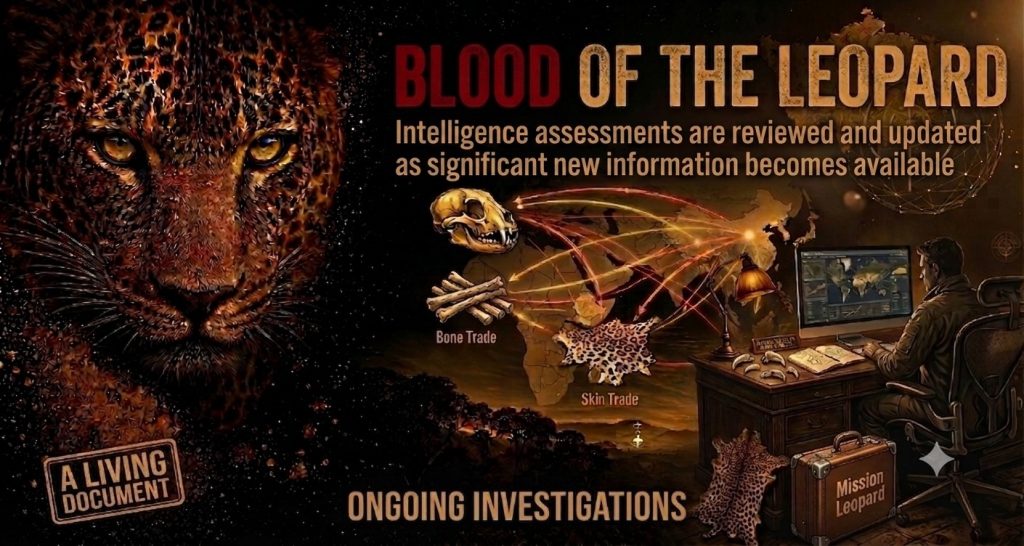
BLOOD OF THE LEOPARD
A Mission Leopard Initiative
SOUTH ASIA INTELLIGENCE BRIEF
Living Intelligence Assessment
Assessment Date: 1 October 2026
Lead Assessment
Illegal leopard trade remains a significant and active threat across South Asia, with the strongest currently documented evidence coming from India.
In 2026, the Wildlife Protection Society of India (WPSI) records 108 leopard cases under its “Poaching & Seizures” category — already matching the figure recorded for the whole of 2025.
At the same time, enforcement operations continue to recover leopard skins and body parts from multiple Indian states, while the Ten Leopard Skins Case has developed from a single seizure into a major multi-jurisdictional investigation involving alleged leopard killings, trafficking activity, recovered remains, trapping equipment and forensic examination.
The case is particularly important because it provides an opportunity to examine the potential chain between leopard mortality at source, the collection and processing of body parts, trafficking networks and eventual seizure.
However, the individual origin of the ten seized skins has not yet been publicly established through definitive forensic evidence. Blood of the Leopard therefore continues to distinguish between confirmed events, reported investigative findings, intelligence leads and analytical assessment.
Recorded seizures should not be interpreted as a direct count of leopards killed for trade. They represent detected activity and provide only a visible part of a much larger and largely concealed system.
Blood of the Leopard therefore follows individual cases beyond the seizure itself — seeking to establish, where evidence permits:
Where did the leopard die?
How was it killed or obtained?
How was the body processed?
Who moved the resulting wildlife articles?
Who were the intermediaries?
Where were those articles ultimately intended to go?
The central intelligence question is not simply how many leopard skins or body parts are seized.
It is what those seizures tell us about the system behind them.
Current Evidence — October 2026
India
WPSI currently records 108 leopard cases under “Poaching & Seizures” in 2026, matching the full-year figure for 2025.
This is a significant indicator of continuing detected wildlife-crime activity. It is not, however, equivalent to 108 individual leopards killed or 108 individual leopards entering trade.
WPSI’s category encompasses reported poaching and seizure cases, and the relationship between cases, animals and wildlife articles must be assessed carefully.
Blood of the Leopard is independently tracking individual seizure cases wherever sufficient information is available, with particular attention to the relationship between:
leopard mortality → body-part recovery → trafficking → market demand
The Ten Leopard Skins Case
The seizure of ten leopard skins in Agra district on 23 July 2026 remains the most significant developing case currently being followed by Blood of the Leopard.
The investigation subsequently expanded across several jurisdictions, particularly into Madhya Pradesh, with multiple arrests reported and investigators examining alleged leopard killings, trapping activity, recovered leopard remains and the possible origins of the seized skins.
The investigation has also generated allegations concerning relationships between some suspects and Wildlife SOS. Those allegations remain unresolved and are not treated by Blood of the Leopard as established facts.
Further procedural developments have included proceedings concerning Wildlife SOS CEO Kartick Satyanarayan. Following Supreme Court directions, Satyanarayan appeared before Madhya Pradesh authorities on 28 September and was questioned in connection with the investigation.
The evidential position remains developing.
The critical unresolved questions include:
- Where was each of the ten leopards killed?
- Can individual skins be forensically linked to recovered remains?
- What role did trapping play in the alleged killings?
- Who obtained and processed the skins?
- Who transported them?
- Who were the intended buyers?
- How extensive was the network behind the seizure?
Read the full case study:
The Ten Leopard Skins Case — Blood of the Leopard Living Intelligence Assessment
The dedicated case study records the evidence, investigative developments, unresolved questions and forensic watch separately and will be updated as the investigation progresses.
Current Regional Assessment
| Intelligence Indicator | Current Assessment |
|---|---|
| Illegal Leopard Trade | HIGH |
| Organised Crime Involvement | HIGH |
| Cross-border Trafficking | SIGNIFICANT / UNDER REVIEW |
| Human–Leopard Conflict | ELEVATED |
| Online Wildlife Trade | INCREASING CONCERN |
| Overall Conservation Outlook | REQUIRES URGENT ACTION |
Why the Cross-Border Assessment Remains Under Review
South Asia contains established international borders, known wildlife-trafficking pressures and historically documented movement of wildlife products between jurisdictions.
However, Blood of the Leopard will not classify a trafficking route or cross-border network as established simply because geography makes it plausible.
Documented connections, intelligence leads and analytical assessments are kept separate.
The current evidence is sufficient to identify cross-border trafficking as a significant intelligence concern, but further case-level evidence is required before assigning a higher-confidence assessment to specific regional trafficking networks.
This distinction is particularly important when examining the movement of leopard body parts between South Asia’s source areas, intermediary locations and potential destination markets.
What Blood of the Leopard Is Watching
Blood of the Leopard currently concentrates on six interconnected intelligence areas:
1. Leopard Mortality and Poaching
Where and how leopards are dying, including deliberate poaching, trapping, poisoning, retaliatory killing and other forms of mortality that may subsequently feed wildlife trafficking.
2. Wildlife Articles
Skins, bones, claws, teeth and other leopard body parts recovered through enforcement operations.
Each type of article can provide different information about the killing, processing and trafficking process.
3. Organised Crime and Networks
The people and relationships connecting leopard deaths with collection, processing, transport, intermediaries, traders and buyers.
4. Human–Leopard Conflict
Conflict can become connected to wildlife crime when a leopard killed because of conflict is subsequently processed and its body parts enter an illegal market.
Understanding this intersection is essential.
A leopard may be killed because it is perceived as a threat, yet the resulting carcass can subsequently become a source of commercial wildlife products.
The point at which conflict ends and trafficking begins is therefore not always clear.
5. Cross-Border Trafficking
Movement of leopard body parts between jurisdictions, including established trafficking routes, emerging routes and suspected connections requiring further evidence.
6. Online Wildlife Crime
The use of social-media platforms, coded language, closed groups and digital marketplaces to advertise, broker or facilitate wildlife trade.
From Seizure to Intelligence
A seizure is an event.
It is not necessarily the end of the story.
Blood of the Leopard attempts to reconstruct the chain wherever evidence permits:
LEOPARD DEATH → PROCESSING → INTERMEDIARY → TRANSPORT → BUYER / MARKET → SEIZURE
Sometimes only one part of this chain is visible.
Sometimes several links can be reconstructed.
The intelligence value of a case increases when those links can be established independently and connected with evidence.
This approach allows Blood of the Leopard to move beyond a simple collection of seizure reports and toward an understanding of the systems that sustain leopard trafficking.
What Is Established — and What Remains Uncertain?
Blood of the Leopard distinguishes between:
FACTS
Information supported by reliable evidence or authoritative reporting.
INTELLIGENCE LEADS
Information that may be significant but requires further verification.
ASSESSMENTS
Analytical conclusions drawn from available evidence and explicitly identified as such.
This distinction is particularly important in developing criminal investigations.
An arrest is not a conviction.
An allegation is not an established fact.
A geographical association is not proof of a trafficking route.
A seized skin is not, by itself, proof of where the leopard was killed.
A recorded seizure is not a measurement of the total scale of leopard mortality.
The Evidence Problem
Recorded seizures are treated by Blood of the Leopard as indicators of detected trafficking activity rather than a direct measure of total leopard mortality.
Wildlife trafficking is inherently difficult to measure because the majority of illegal transactions are never observed by enforcement authorities.
Consequently, an increase in recorded seizures can mean several things:
- trafficking activity may have increased;
- enforcement activity may have become more effective;
- intelligence-led operations may have improved detection;
- reporting may have improved;
- or several of these factors may be operating simultaneously.
For this reason, Blood of the Leopard does not equate seizure numbers directly with population-level mortality.
Instead, we examine patterns, cases, geography, methods, networks and enforcement responses together.
Geographic Coverage
Primary Intelligence Region
South Asia
Current assessments focus on:
- illegal leopard trade
- organised wildlife crime
- human–leopard conflict
- cross-border trafficking
- online wildlife crime
- conservation and enforcement policy
Developing Regions
Southeast Asia — intelligence development underway
Africa — intelligence development underway
Central Asia — future expansion
Middle East — future expansion
The initial focus remains South Asia because this is where Blood of the Leopard currently has its strongest developing intelligence base.
Expansion will occur as evidence, partnerships and case-level intelligence allow.
Why This Panel Exists
Blood of the Leopard is a living intelligence publication.
It is designed to do more than report individual seizures.
Its purpose is to continually assess what individual incidents may reveal when considered together:
What is happening?
Where is it happening?
Who appears to be involved?
How are wildlife articles moving?
What is driving the trade?
Where are the intelligence gaps?
What should conservation and enforcement agencies be watching next?
The publication therefore changes as the evidence changes.
Individual case studies may develop at different speeds from the regional assessment, and new evidence may alter an existing assessment.
This is deliberate.
Observe → Understand → Decide → ACTION
Current Intelligence Position
As of 1 October 2026, the available evidence supports the following overall position:
Leopard trafficking remains a high-significance conservation and wildlife-crime threat in South Asia. India currently provides the strongest publicly documented evidence of continuing illegal trade, with WPSI recording 108 leopard cases under “Poaching & Seizures” in 2026 and several significant enforcement operations.
The Ten Leopard Skins Case has become an important developing investigation because it potentially connects leopard mortality, trapping, wildlife articles and trafficking activity across multiple jurisdictions. However, the precise origin of the ten skins and the full trafficking chain remain unresolved.
The evidence does not yet permit Blood of the Leopard to quantify total leopard mortality attributable to trafficking, nor to conclusively map the full regional trafficking network.
These remain active intelligence priorities.
The next stage of Blood of the Leopard will therefore continue to examine the South Asian evidence in greater depth — bringing together individual cases, seizure patterns, mortality, trafficking mechanisms, enforcement intelligence and evidence gaps.
Assessment Status
Assessment Status: ACTIVE / DEVELOPING
Last Updated: 1 October 2026
Individual Blood of the Leopard case studies and intelligence assessments may be updated independently as new evidence becomes available.
Blood of the Leopard distinguishes confirmed events, reported investigative findings, intelligence leads and assessment.
The publication is intended to remain a living intelligence record rather than a static report.
Mission Leopard is an entity of WildTiger.
