
Blood of the Leopard (BoL) – Living Intelligence Assessement and Blood of the Leopard (BoL) – Overview and Links to Sections.
Global Trade in Leopard Parts An Investigation into Transnational Demand
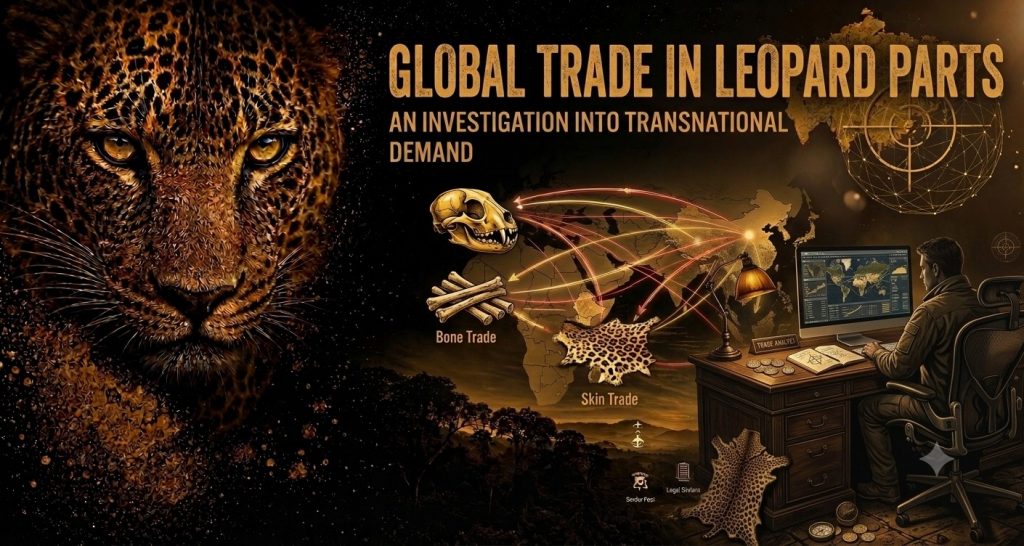
Global Demand — Multiple Markets, One Animal
The leopard’s vulnerability is the breadth of what it is worth dead
Between 2000 and July 2024, reported incidents point to at least 6,829 leopards detected in illegal trade (EIA and WPSI, 2024) Source CatByte – This information is based on seizure data. As stated in relevant sections in Blood of the Leopard, various multipliers are used to estimate the number of leopards killed for the resulting trafficking of their body parts. The true numbers can never be known but what is certain is that many more thousands of leopards are killed than the indicator figures.
The Demand Problem
Most illegal wildlife trade policy focuses on supply — the poachers, the networks, the seizure points, the enforcement failures. Supply-side intervention is necessary. It is not sufficient. The leopard parts trade persists because there is demand for leopard parts across multiple product categories, multiple cultures, and multiple geographies simultaneously. Until the demand is addressed with the same seriousness as the supply, the economics will continue to favour the trade.
Data from the Environmental Investigation Agency (EIA) Global Environmental Crime Tracker shows that at least 6000 whole leopards, or their equivalents in products, have been seized since the year 2000 in Asia alone. When combined with other datasets from India, Debbie Banks of EIA puts this number at a minimum of 6,400 leopards. These are the documented seizures. The actual volume of trade is considerably higher as stated in the opening paragraph.
The Skin Trade: A Worldwide issue with changing markets
To understand the illegal trade of leopard skins in Asia alone, it is important to note that leopard and tiger skins are more often than not trafficked by the same criminal networks using the same supply chains. For the purpose of this report (and for a follow up report focusing on tiger parts), the term ‘big cat’ will often be used – as stated both leopard and tiger skins are to be the understood derivative with at times snow leopard and clouded leopard skins included, those will be referenced as such depending on the context.
For some time the most visually dramatic and historically significant demand for leopard skins came from Tibet — where the chuba, the traditional long robe of Tibetan culture, is adorned with big cat skin trim along its collar, cuffs, and hem.
The minimal use of tiger and leopard skins on trims of clothing was once only found in eastern Tibet among a small fraction of the population, but became a fashionable practice among Tibetans from the Tibet Autonomous Region, western Sichuan, Qinghai, northwest Yunnan, and southern Gansu provinces.
At colourful summer horse festivals in Tibet and Sichuan, investigators found hundreds of skins being worn by masked dancers and horse riders, as well as spectators, and even organisers and local officials. They were usually stitched onto chubas. Complete skins were also being sold in large quantities in small shops in Lhasa and other towns — all openly, illegally, and without any evidence of control.
The 2004 report by the International Investigation Agency (EIA), The Tiger Skin Trail, mapping transnational smuggling routes and the sheer volume of whole skins available in Tibet was followed by a 2005 Exposé when the Wildlife Protection Society of India (WPSI) and EIA jointly released a hard-hitting report detailing the devastating scale of the skin trade, shifting the conservation focus from tiger bones to pelts.
“If you don’t have a tiger skin, people look down on you,” one Tibetan woman told investigators. “My sister recently went to a company party where she was the only one who wasn’t wearing one. She went out and bought one right after the party.”
2006 Dalai Lama Appeal
Following these findings, his Holiness the Dalai Lama publicly appealed to Tibetans to abandon wearing and trading endangered animal skins. This led to massive, historic public burnings of chubas and pelts across Tibetan regions, marking a significant drop in demand. The landmark report, Skinning the Cat, released by EIA and WPSI in June 2006, covers this time period with the massive seizure of 531 leopard skins, 31 tiger skins and 778 otter skins by Chinese authorities in Tibet in 2003 providing impetus to the subsequent investigations.
Understanding the Fluid Nature of the Trade
The social status dimension of the chuba trade is critical. This is not ceremonial use in the traditional sense — the skins are not prescribed by religious or cultural practice. When questioned, all the Tibetans investigators talked to admitted that neither their fathers nor grandfathers had worn skins. This is a modern fashion phenomenon, driven by social aspiration, that has created an industrial-scale demand for big cat skins from Indian and Nepali forests. The supply chain for the chuba market is the India–Nepal–Tibet–China corridor documented in the Trafficking Network section of this report. Ommcom News
Current Situation
While consumer demand from the Tibetan community collapsed significantly following the 2006 public burnings, subsequent investigations—such as the EIA report Out in the Cold—have noted that the trade continued to adapt. Trafficking shifted toward supplying skins for luxury home décor, taxidermy, and wealthy Chinese buyers. [1, 2, 3] – WildTiger/Mission Leopard investigations in collaboration with partners are ongoing. There will be updates at this platform when appropriate. At the bottom of this page under the heading Africa: The Open Market there is a brief overview of the leopard skin trade in that region – this will be expanded upon as indicated.
Traditional Chinese Medicine and the China Loophole
The most structurally significant demand driver for leopard parts is China’s traditional medicine industry — and the legal framework that sustains it.
In 1993, the Chinese Ministry of Health approved leopard bone as a formal substitute for tiger bone in TCM formulations, at the same moment it banned tiger bone use. The ban on one species created state-sanctioned demand for another. In 2006, China issued regulations ordering that only existing stocks of leopard bone could be used for TCM and that no new stocks could be used. No information on the scale of those stocks is publicly available. In 2014, the government approved a brand of leopard bone wine as “intangible cultural heritage” and in 2018 it approved the sale of 1,230.5kg of leopard bone to a company manufacturing it. wildleopard
EIA’s investigation Investing in Extinction identified the body parts of threatened leopards being used as ingredients in at least 88 traditional Chinese medicine (TCM) products, manufactured by 72 Chinese companies and licensed by the National Medical Products Administration of China. ResearchGate
Given the international commercial trade ban since 1975, China’s accession to CITES in 1981, and the small leopard population within China, it is unclear how procurement for licensed leopard products is being met through legal supplies. When viewed in light of the high global levels of poaching and illegal trade of the species, it seems clear that China’s regulations for leopards do not satisfy CITES recommendations for the species. wildleopard
As of 2024, more than 100 financial institutions and banks based outside China were invested in two of the TCM conglomerates producing leopard bone products. Among them: household names in global finance, including institutions based in Australia, Canada, the EU, Japan, Switzerland, the UK, and the USA. The leopard parts trade is not a peripheral criminal activity. It is embedded in the financial systems of countries whose governments have signed international treaties to protect the species being traded. deccanherald
One company, Hongmao Pharmaceutical Co. Ltd, was permitted to buy 1.23 tonnes of leopard bone in a single transaction in 2018 — equivalent to the bones of approximately 150 leopards. Beijing Tongrentang, valued on the stock market in 2019 at 37.5 billion yuan and the world’s largest producer of traditional Chinese medicine, with branches and subsidiaries in the UK and USA, produces more leopard products than any other company. WcnWcn
This section of Blood of the Leopard will be substantially expanded following a collaboration with EIA’s Tiger and Wildlife Crime Campaign. The China loophole — its policy history, its current status, and what closing it would require — is one of the most important enforcement stories in leopard conservation. It will receive the depth it deserves.
Claws, Teeth, and Bones: The Retail Trade
Beyond the skin and TCM markets, a retail-level trade in individual leopard parts operates across multiple countries and increasingly online.
Leopard claws and teeth are traded as jewellery, amulets, and status items across India, Southeast Asia, and Europe. CatByte data identifies claws as the most commonly seized commodity in leopard trafficking between 2020 and 2025 — reflecting the volume of the retail trade rather than the value of any individual item. The Lucknow case documented in the Enforcement Gap section — 18,000 leopard claws representing approximately 1,000 animals — is the most extreme documented instance of claw aggregation, but the retail trade operates continuously at smaller scale across dozens of markets. INTERPOL
In Karnataka, Operation Clawing Back found leopard claw jewellery being sold openly in Rohru market — goods that required a supply chain operating through or alongside the wildlife protection infrastructure. Leopard skulls appear in European collector markets, traded at auction and through specialist dealers with varying degrees of documentation. Big cat skull and bone fragments are sold as decorative items and ritual objects across West Africa, with EAGLE Network teams documenting open market sales annually.
Traffickers exploit weak regulations to mislabel leopard parts as tiger products, allowing them to meet the high demand for traditional medicine and luxury items in Asian markets. The substitution dynamic — leopard sold as tiger, leopard bone processed into products labelled with tiger branding — means that the demand for tiger parts directly generates demand for leopard parts, even in markets where the buyer believes they are purchasing something else entirely. Nepali Times
Live Animals: The Exotic Pet Trade
Live leopards are sold as exotic pets — primarily in the Gulf states, where wealthy collectors have historically maintained private menageries of big cats. The UAE introduced legislation in 2016 banning the ownership of dangerous wild animals, with fines of up to USD 136,000 and jail terms for public display — but enforcement has been inconsistent and the demand has simply shifted to less visible channels. Nepali Times
The exotic pet trade for leopards operates through the same Southeast Asian criminal networks documented in the Crime Convergence section. Alive or dead, leopards are traded as commodities to satisfy the growing demand for exotic pets, or for their bones, skulls, and skins to be used in traditional medicine, luxury products, or trophies. A live cub, if it survives the journey — and many do not — commands a significant premium over parts from a dead animal. The Gulf market for live big cats is not new, but its persistence in the face of legal prohibitions reflects the same enforcement gap documented across the parts trade: the legal framework exists. The enforcement does not match it. Earth Eco Balance
Trophies and the Legal Trade
Data from CITES, which records all legal international trade in listed wildlife species, shows that 8,303 trade permits were issued for leopards from 2000 to 2024, making them the most traded big cat listed on CITES Appendix I. Hunting trophies comprise the largest number of permits, at 4,165, followed by 1,099 permits for skins and 933 for skulls. INTERPOL
A 2016 report by IFAW on the trophy hunting industry found that more than 10,000 leopard trophies were legally traded worldwide between 2004 and 2014, with leopards being the most imported trophies among big cats. INTERPOL
The legal trophy trade is a contested area. Its proponents argue that it generates conservation funding and community income. Its critics argue that it provides cover for illegal parts and that the documentation trail — permits, certificates, customs declarations — is routinely exploited by traffickers to launder illegally sourced material. The evidence for the latter is documented in multiple CITES reports and enforcement investigations. The debate, however genuine its conservation dimensions, cannot be separated from the reality that the legal trade in leopard trophies is occurring simultaneously with the largest illegal trade in leopard parts ever documented.
Africa: The Open Market
Africa has a booming trade in leopard parts, said Ofir Drori, founding director of the EAGLE Network. Each year, EAGLE seizes about 30 leopard skins from traffickers in West, Central, and East Africa. Drori has stated plainly that this figure represents a fraction of actual trade and that he sees an increase year on year. INTERPOL
A 2025 market survey in Côte d’Ivoire found leopard parts for sale in nearly half of 46 markets surveyed. West African leopard parts serve both local ceremonial demand — ritual use, traditional medicine, status display — and an export market feeding into the global trafficking network. The same Chinese criminal networks documented in Operation Sandokan’s Southeast Asia investigation maintain supply chains reaching Africa. The leopard’s pan-continental range means the supply base extends from the forests of Cameroon to the highlands of Ethiopia — a geography of source countries that no single enforcement jurisdiction can address.
Blood of the Leopard will cover the African demand and supply picture in depth in the forthcoming Africa Context companion report, which will draw on the operational expertise of Ofir Drori and the EAGLE Network.
Why Demand Is the Problem No One Is Solving
The six markets documented in this section are not separate problems. They are expressions of a single underlying reality: the leopard has economic value dead, across too many product categories and too many geographies to be addressed through supply-side enforcement alone.
Demand in China is one of the primary drivers for the global illegal trade of leopards. Although other markets exist, the China TCM system — with its legal framework that accommodates rather than eliminates the use of leopard parts — is the structural heart of the demand problem. Closing it requires political will at the level of the Chinese government, sustained diplomatic pressure from CITES parties, and — as EIA’s Investing in Extinction report makes clear — pressure on the international financial institutions that profit from the companies producing these products. deccanherald
The Tibetan skin market requires a cultural intervention — the kind that has worked before. When the Dalai Lama publicly condemned the wearing of wildlife skins in 2006, Tibetans across the region burned their chuba skins in public demonstrations of solidarity. The demand contracted sharply. Cultural shifts can move faster than legislation. But they require sustained effort, and the gains made in 2006 were not permanent. Ommcom News
The retail claws and teeth trade, the live animal market, the trophy trade, the African open markets — each requires its own targeted intervention. None of them are receiving it at a scale proportionate to the problem.
“It’s tragic to see how these majestic creatures have turned into mere commodities,” says Vanessa Amoroso, head of wild animals in trade at FOUR PAWS. “Leopards are being killed as substitutes for tigers, purposely mislabelled, their bones traded in wildlife markets in Asia to become traditional medicine, luxurious accessories, trophies, and more.” Earth Eco Balance
The worldwide responsibility argument is simple. The demand that kills leopards in Indian forests and Nepalese hills does not stay in Asia. It passes through the financial systems of Europe and North America. It sits in the portfolios of pension funds and investment banks. It moves through the trophy import licences of wealthy hunters from the US, the UK, and Europe. It lives in the exotic pet collections of Gulf state collectors and in the collector markets of Continental Europe.
The leopard is being consumed by the world. The world’s response, so far, has not matched the scale of what it is consuming.
This section will be substantially expanded following further investigation in collaboration and consultation with key partners. Blood of the Leopard is a living document published by WildTiger /Mission Leopard.
wildleopard.net · wildtiger.org
