
Blood of the Leopard (BoL) – Living Intelligence Assessement and Blood of the Leopard (BoL) – Overview and Links to Sections.
The Trafficking Network How Leopard Parts move from Habitat to Market
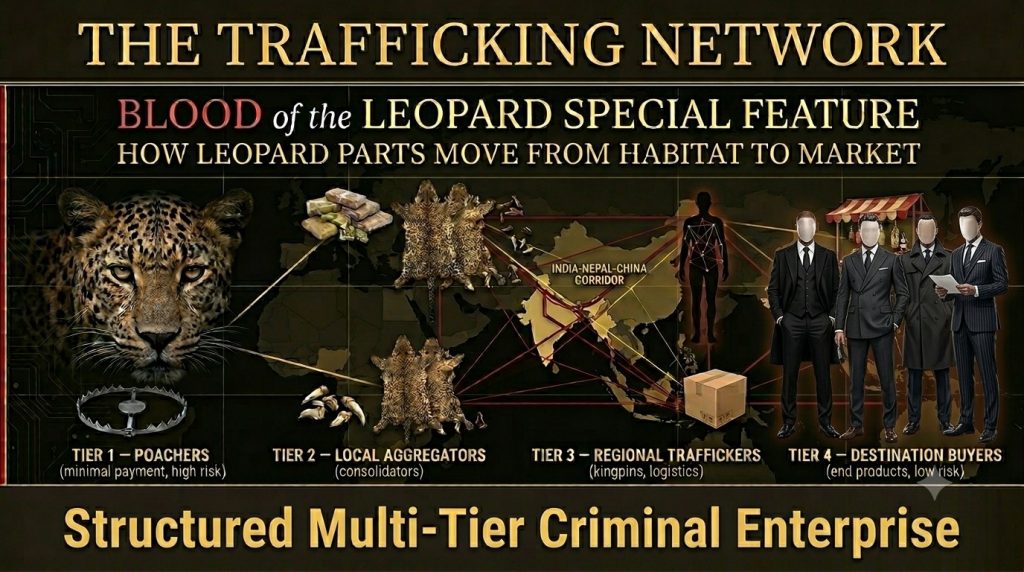
## How leopard parts move from habitat to market
**A Multi-Tier Criminal Enterprise**
The illegal leopard trade is not a spontaneous or purely opportunistic phenomenon. At its core it is a structured criminal enterprise — multi-tiered, transnational, and deeply embedded in the same networks that traffic tiger parts, pangolin scales, rhino horn, and narcotics. The structure is broadly consistent across the range, operating with the efficiency of a logistics company and the impunity of an institution that has correctly calculated its legal risk.
—
**Tier 1 — Poachers**
At the base of the network: local hunters, often from forest-dwelling communities with tracking skills developed across generations. The Bawariya community of northern and central India — skilled trackers, labelled a “criminal tribe” by British colonial law in 1871 and denied legitimate livelihoods ever since — are the most documented Tier 1 workforce in the South Asian leopard trade. They kill leopards using snares, poison, and electrocution. Payment at this level is minimal — a leopard skin may exchange hands for USD 50–200 at source. The snare is the most common acquisition tool, requiring minimal skill, capital, or physical presence at the kill site.
The poacher carries the highest enforcement risk in the entire network. They are the most visible, the most likely to be caught, and the least consequential to the overall operation when arrested. The network above them is designed to ensure this.
—
**Tier 2 — Local Aggregators**
Above the poachers: middlemen who collect parts from multiple sources and consolidate them for onward movement. This tier provides the critical buffer between the kill site and the organised criminal network. Aggregators insulate the upper tiers from detection while absorbing the second-highest level of enforcement risk. They know more than the poachers but less than the kingpins — enough to be useful, not enough to cause serious damage if arrested.
This is the tier that appears most frequently in seizure records and arrest reports. A vehicle stopped on a rural road with leopard skins wrapped in blankets, moving between districts. A dhaba owner in Odisha holding skins on behalf of a buyer he has never met in person. The aggregation tier is where individual kills become consignments.
—
**Tier 3 — Regional Traffickers**
The kingpins. Figures like Sansar Chand, Kunjoc Lama, Ramjas Banjara, and Yangchen Lachungpa — documented in the case files of intelligence agencies across India, Nepal, and Tibet — who coordinate collection across state and national boundaries, manage logistics, and maintain relationships with destination market buyers. This tier rarely handles contraband directly. The physical distance between the kingpin and the leopard skin is the operational security that makes prosecution so difficult.
Sansar Chand operated for four decades from Sadar Bazar in Old Delhi — a wholesale market whose volume and variety of legitimate trade provided consistent cover. He coordinated poaching networks across nine Indian states, managed buyers from Nepal and Tibet, and never needed to touch a skin himself. He admitted in CBI interrogation to selling 2,130 leopard skins to just four buyers. His conviction — fifteen times — never once produced a sentence proportionate to the crime.
—
**Tier 4 — Destination Buyers**
At the apex: traders and retailers in China, Vietnam, the Middle East, and increasingly Europe, who convert raw parts into saleable products — medicinal preparations, jewellery, fashion items, ceremonial robes, trophies — for end consumers. This tier bears virtually no legal consequence whatsoever. The buyers who received Sansar Chand’s 2,130 leopard skins were never identified, never charged, and never faced any enforcement action. They are, in the documented record of leopard trafficking, almost entirely invisible.
This invisibility is structural. Destination market enforcement is chronically under-resourced, diplomatically sensitive, and reliant on cross-border intelligence cooperation that rarely materialises at the level the trade demands.
—
**The Nepal–India–China Corridor**
One of the primary transnational route for South Asian leopard parts runs north. Parts sourced across India — from Rajasthan, Madhya Pradesh, Odisha, Uttarakhand, Karnataka, and the Northeast — are consolidated in or near Kathmandu and moved north through the Rasuwa and Kodari border crossings into Tibet and onward to Chinese markets.
Nepal’s role as a transit hub is thoroughly documented. A single Rasuwa seizure yielded five tiger skins, 36 leopard skins, and 113 kg of tiger bones in a single consignment destined for China — with Kunjoc Lama, one of Nepal’s most wanted wildlife traffickers, named as the organiser. The 109 leopard skins seized near Swayambhu Temple in Kathmandu in April 2003 — at the time the largest single leopard skin seizure on record — were all Tibet-bound, coordinated by a Tibetan contact operating remotely. The corridor is not historic. It is active.
Nepal’s CIB has in recent years conducted 31 raids resulting in 73 tiger smuggler arrests — nine Indian nationals and two Chinese among them. Seizures in this period include 28 tiger pelts and 139 kg of tiger bones. Leopard parts move through the same routes: the India–Nepal–Tibet corridor is not a tiger trafficking route that leopards occasionally use. It is the primary artery for big cat parts of all species.
The Eastern Corridor — West Bengal, Bangladesh, Myanmar and the Golden Triangle
The Nepal–Tibet–China corridor is the most extensively documented transnational route for South Asian leopard parts. It is not the only one. Intelligence gathered by Mission Leopard and corroborated by partner sources indicates an eastern corridor of significant and growing concern — one that connects India’s leopard range to destination markets through a fundamentally different geography and a distinct set of criminal networks.
Parts sourced across India’s eastern range states move toward West Bengal — arriving either through East Nepal or via direct routes from adjacent Indian states. From West Bengal, the corridor tracks east through Bangladesh and into Myanmar, where it connects with the established criminal infrastructure of the Golden Triangle. The markets of Mong La — documented by Earth League International’s Operation Sandokan as a hub where multiple species are traded openly alongside drugs, counterfeit goods, and other contraband — represent a documented destination and distribution point for parts moving through this corridor. The northeastern Indian states present a parallel dimension: a long, porous border with Myanmar where, according to intelligence under active assessment, direct pick-ups on the Myanmar side are part of the operational pattern.
Mission Leopard regards this corridor as a priority area for ongoing investigation. The full picture — source areas, aggregation points, border crossing methods, and destination markets — is not yet complete, and operational considerations mean that detailed findings will be published when the investigation has reached an appropriate stage. A comprehensive analysis will form a core element of the forthcoming South Asia Context companion report.
What can be stated now is this: the Nepal–Tibet–China corridor and the eastern corridor through Bangladesh and Myanmar are not competing explanations for how South Asian leopard parts reach Chinese and Southeast Asian markets. They are parallel routes within the same system — served by the same demand, adapted to the same enforcement landscape, and together accounting for a volume of trade that neither corridor alone can explain.
—
**The Digital Dimension**
The trade has evolved. The era of bulk physical consignments moving through fixed corridors has given way to a more distributed, harder-to-intercept model — and alongside it, a parallel digital marketplace that operates largely beyond the reach of conventional enforcement.
A May 2026 Mongabay investigation documented that Facebook’s closed group architecture, combined with its resistance to systematic monitoring, makes it structurally suited to the illegal wildlife trade. Traffickers use coded language — emojis substituting for protected species names, deliberate misspellings, video-only listings to defeat text screening — to conduct transactions across international borders in real time. Bellingcat’s parallel investigation identified the specific coded language used: a system that connects buyers and sellers efficiently while evading automated detection.
After Mongabay and Bellingcat’s joint investigation in March 2026, Facebook shut down identified Indonesian wildlife trade groups. The same trade re-established itself on adjacent platforms and new groups within days. The trade is adaptive. Enforcement is not.
—
**Africa — An Emerging Source Region**
While South Asia dominates the documented seizure record, Africa is an increasingly significant source and transit region. African leopard parts — skins, bones, claws — enter trade channels serving local ceremonial demand and export markets in the Middle East, Europe, and China. A 2025 market survey in Côte d’Ivoire found leopard parts for sale in nearly half of 46 markets surveyed. Nigeria’s NESREA arrested a wildlife criminal in 2026 after a five-year manhunt. The EAGLE Network’s Ofir Drori has stated plainly that he sees an increase year on year in African leopard skin trafficking — and that the seizure figures represent a fraction of actual trade.
The African trafficking dynamic differs from the South Asian one in structure but not in logic. The same four tiers operate. The same impunity at the top persists. The same enforcement gap enables both.
**The Southeast Asia Hub — Cambodia, Laos, and the Lower Mekong**
The trafficking corridor documented in South Asia — India to Nepal to Tibet to China — is one artery in a global network. Southeast Asia represents a parallel and increasingly significant hub, with Cambodia and Laos functioning as major consolidation and transit points for wildlife parts sourced across Asia and Africa and destined primarily for Chinese markets.
In June 2026, Earth League International released Operation Sandokan — the most extensive undercover investigation into wildlife trafficking ever conducted in Cambodia. Its findings provide the most detailed public picture yet of how the Southeast Asian tier of the global wildlife trafficking network operates.
At the centre of the operation: two persons of interest designated Cam1 and Cam2, described by ELI as the largest wildlife traffickers they have encountered to date, and contenders for the biggest in the entire Lower Mekong. They operate nine shops throughout Cambodia, own businesses in Laos, Thailand, and Vietnam, maintain warehouses, a factory, and a brewery producing tiger bone wine. Ivory and rhino horn products are carved at their facility in Vietnam. Their supply chains reach Africa, Europe, Russia, and South Asia. Cam1 described their supply as “endless.”
The logistics methods documented by ELI are directly relevant to understanding how any high-value wildlife contraband — including leopard parts sourced in South Asia — moves through this corridor. Air routes from source countries were deliberately nonsensically complex, designed to obscure trafficking patterns. Wildlife products including ivory were frequently routed through third countries and relabelled to avoid scrutiny. Small high-value items — tiger teeth, pangolin scales, and by extension leopard claws — were altered into jewellery or ground into powder when being carried, worn, or shipped to high-risk destinations including mainland China. Human mules were used across littoral border crossings. The methods are adaptive, diverse, and specifically designed to exploit the gaps in conventional enforcement.
The corruption infrastructure that enables this network is as significant as the logistics. ELI documented high levels of collusion between Chinese criminal networks and Cambodian political and business elites. Persons of interest were photographed with high-ranking politicians. They named their political protectors openly — as a demonstration of power, not as a risk. Port and airport access was facilitated by enablers in both public and private sectors. Special Economic Zones, designed for legitimate trade, were systematically exploited as transit infrastructure for contraband.
The network is adaptive. Following crackdowns on Cambodia’s scam compound industry in late 2025, criminal groups relocated to Laos, Burma, and Sri Lanka. Laos — with consolidated family-based political control and a high-speed rail connection to China — has been identified by ELI as the emerging next hub. The trade does not contract when pressure is applied. It moves.
ELI’s conclusion on how to address this is unequivocal: given the direct involvement of national elites in these criminal economies, reform from within is insufficient. External action — by international law enforcement, CITES parties, and diplomatic partners — is the only realistic mechanism for disruption at the scale required.
The South Asia corridor and the Southeast Asia hub are not competing explanations for how leopard parts reach Chinese markets. They are complementary routes within the same global system — served by the same Chinese demand, the same corruption infrastructure, and the same impunity at the apex of the network.
*Source: ELI, Operation Sandokan: Unmasking the Lower Mekong’s Biggest Wildlife Traffickers, June 2026. Full report at earthleagueinternational.org.*
**What the Network Requires to Function**
Understanding the trafficking network as a structure — rather than a collection of individual criminals — clarifies what is required to disrupt it.
Removing Tier 1 actors without addressing Tier 3 replenishes the workforce. The poachers who are arrested are replaced by others from the same communities facing the same economic conditions. Seizing individual consignments without disrupting the logistics infrastructure relocates the trade rather than reducing it. Prosecuting aggregators without targeting kingpins removes the visible layer while leaving the organising intelligence intact.
The Sansar Chand case illustrates this precisely. His death in 2014 did not end the network. His routes, his buyers, his relationships with Tier 1 poaching communities — these persisted. The infrastructure he built continues to function under different management.
Disrupting the leopard trafficking network requires sustained, intelligence-led operations targeting Tier 3 actors specifically — the Yangchen Lachungpas, the Kunjoc Lamas, the successors to Sansar Chand — with the same investigative resources, cross-agency coordination, and international legal tools that the Lachungpa arrest in December 2025 demonstrated are available when the institutional will exists to deploy them.
That will remains the exception. The trade continues to benefit from its absence.
—
*Blood of the Leopard is a living document published by Mission Leopard / WildTiger.*
*wildleopard.net · wildtiger.org*
