
Blood of the Leopard (BoL) – Living Intelligence Assessement and Blood of the Leopard (BoL) – Overview and Links to Sections.
The Odisha Problem A regional problem and lead-in to the forthcoming South Asia Context report
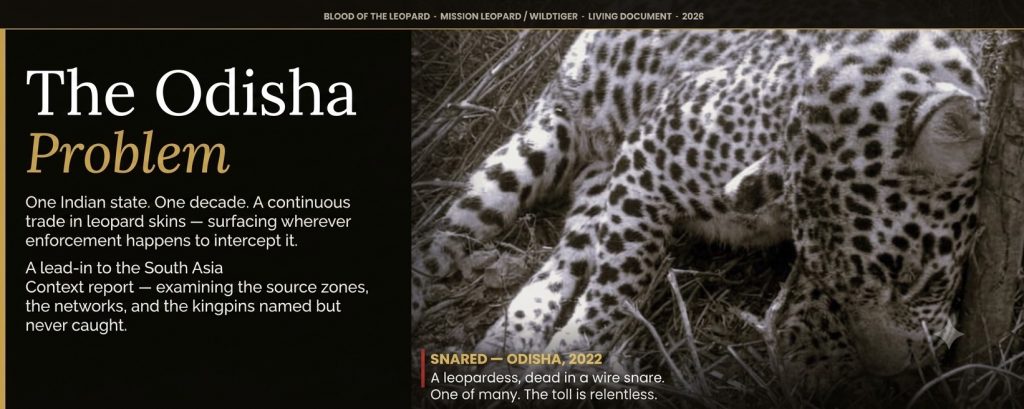
This section is a focused preview of a single state’s leopard trafficking crisis — a lead-in to Blood of the Leopard’s forthcoming South Asia Context report. It is built on open-source enforcement reporting, primarily the press releases of the Odisha Police Special Task Force as carried by national and regional outlets, alongside peer-reviewed research and conservation-sector commentary. Where individuals are named in undecided cases, they are alleged throughout. Where figures derive from a single enforcement source, that is stated. This section will be updated and expanded as primary records are reconciled.
Why Odisha
If you want to understand the leopard parts trade in India, you can do worse than start in Odisha. Not because it is the largest source — the trade is national, and its most active hubs shift over time — but because Odisha is where the trade is most visibly documented. The state generates more leopard-skin seizure reporting than almost any other in India, and the reason is instructive: a specialist enforcement body that actually pursues these cases, records them, and publicises the results.
That makes Odisha a rare thing in the leopard trafficking landscape — a place where the scale of the trade is partially measurable, where enforcement both succeeds and fails in documented ways, and where the structural arguments running through this entire report can be tested against a decade of hard case data. Odisha is not the worst of the problem. It is the clearest window onto it.
The Headline Picture
The Special Task Force of Odisha Police was granted wildlife-crime authority in 2018, and intensified its wildlife work from around 2020. The results, as reported by the STF itself, are substantial — and the running total has climbed steadily and continuously.
By mid-2024, the STF reported having detected 100 wildlife cases, arrested 232 wildlife criminals, and seized 58 leopard hides — alongside 27 elephant tusks, 2 tiger hides, 23 live pangolins, pangolin scales, and 11 deer hides. The leopard-skin figure had risen in an unbroken climb across successive press releases: from around 19 reported in late 2021, to 22 by December 2021, to 25 by February 2022, to 27 by April 2022, to 30–32 across the following months of 2022, to 58 hides by mid-2024.
Separately, conservation-sector estimates have put at least 150 to 160 leopards poached in Odisha over the preceding decade — a figure attributed to wildlife activists rather than enforcement records, and therefore an assessment rather than a confirmed count. But it sits in plausible relation to the seizure data: if dozens of skins were intercepted, the number actually killed — given that seizure captures only a fraction of any trade — is inevitably a substantial multiple.
Each of those skins was a leopard. The trade does not deal in abstractions. It deals in hides, and every hide was an animal that was, until an aggregator’s phone call, alive.
A Decade of Seizures
The year-by-year record, assembled from enforcement reporting, shows a trade that is continuous, geographically dispersed, and persistent across the entire decade — not a series of isolated events, but a steady current.
2020 opened with a leopard skin seized at the Odisha–Chhattisgarh border, four skins in Nayagarh, five seized by the STF in July, and five more across Nabarangpur and Berhampur in a four-day span in September, alongside a case in Bargarh that would later produce a conviction (see below). 2021 saw a leopard skin traced from a Facebook sale post in the Similipal landscape, two skins in Boudh, further skins across Mayurbhanj (including the Bisoi case, two arrested near Chatani bus stop) and Khurda, and a running STF one-year total, by November, of 19 skins and 39 arrests.
2022 was a sustained, near-monthly run across the state: Betnoti, Jasipur (leopard teeth and claws alongside pangolin scales), Daringbadi, Balangir, a Koraput arrest near Ramgir Gupteswar Gate, a Kalahandi arrest on the Bhawanipatna–Rayagada highway, and a Kandhamal arrest in Chakapada — each following the same pattern: ground-level intelligence, a suspect about to strike a deal, a single skin recovered. By that August, the STF’s two-year running total stood at 32 leopard skins, 2 teeth, and 29 claws — a static claws-and-teeth figure that would recur unchanged in subsequent releases, indicating a single underlying seizure carried forward in the cumulative tally rather than a repeated event.
2023 brought three leopard skins recovered in a single raid in Rayagada, on the Rayagada–Koraput highway. 2024 saw a Nayagarh seizure in Dasapalla, a forest-department bust of an inter-state racket in Gajapati — five leopard skins plus a fishing cat and a leopard cat skin, seven arrested, the alleged kingpin reportedly still at large — and, that October, the STF’s ninth successive wildlife-crime conviction, a milestone the force explicitly measured against a national wildlife conviction rate it cited as under five per cent.
2025 included a leopard skin seized alongside elephant tusks valued at around Rs 50 lakh, a December case in Boudh district (Manmunda–Sagada road), and a Bhubaneswar case in which the STF stated the network had sourced skins from Boudh, Nayagarh, and Phulbani forests for movement onward toward West Bengal — with an unapprehended kingpin.
2026 has already produced multiple cases: a Boudh district arrest in Purnakatak in the year’s early months, resulting in a further conviction; a leopard skin in Nabarangpur in April, reportedly sourced from the Karlapat Wildlife Sanctuary and being moved toward Koraput by motorcycle before the traffickers, sensing surveillance, diverted through interior forest; a leopard skin with 164 pangolin scales in Nayagarh; and in June, the Ganjam seizure — two leopard skins recovered alongside two improvised explosive devices and a sword. That weapons element, documented elsewhere in this report under Crime Convergence, was the notable anomaly in an otherwise grimly familiar pattern.
The rhythm is the point. This is not a series of unconnected incidents. It is a continuous trade, surfacing wherever enforcement happens to intercept it — month after month, district after district, for at least six years running.
The Geography — Three Source Zones
The Odisha seizure record reveals three persistent source zones, repeated across the decade.
The Kandhamal–Boudh–Phulbani–Nayagarh belt in the south-central part of the state is the densest and most repeated sourcing hub — the area enforcement reporting returns to most often, and the belt explicitly tied to a trafficking network in the 2025 Bhubaneswar case.
The south-western arc — Kalahandi, Koraput, Nabarangpur, Balangir, Nuapada, Rayagada, Gajapati — runs along the Chhattisgarh border and draws on protected areas including the Karlapat Wildlife Sanctuary. Its position against a state border is not incidental: border-adjacent zones consistently facilitate the movement of contraband across enforcement jurisdictions.
The Mayurbhanj–Similipal landscape in the north — Baripada, Bisoi, Betnoti, Jasipur — clusters around the Similipal Tiger Reserve, where the displacement dynamics documented in this report’s Habitat section place additional pressure on leopards at the forest edge.
Onward-movement indicators from enforcement reporting point toward West Bengal as a transit and destination node, connecting Odisha’s trade to the broader eastern corridor and, ultimately, to the international demand documented across Blood of the Leopard. That onward linkage, drawn from enforcement statements, remains an area for further evidential work — and will be developed in the South Asia Context report.
The Pattern of the Trade
Several features of the Odisha record illustrate, with unusual clarity, the structural arguments that run through this report.
The seizures happen at the transaction, not the kill. Case after case follows an identical pattern in the enforcement record: a suspect “about to strike a deal to dispose of the skin,” intercepted on specific ground-level intelligence. This means enforcement is consistently catching the trade at the aggregator and transaction tier — rarely at the kill site, and rarely at the apex. It is catching the middle of the network, not its top or its bottom.
The kingpins are named but not caught. Across multiple cases, organisers are repeatedly referenced in enforcement statements but not apprehended. The Gajapati 2024 mastermind, “reportedly still at large.” The 2025 Bhubaneswar network’s unapprehended organiser. This is the four-tier structure documented in this report’s Trafficking Network section, operating exactly as the model predicts: the apex carries the least enforcement risk, and it shows in case after case, year after year, in a single state’s record.
The digital shift is visible. The 2021 case traced from a Facebook sale post is an early, concrete Odisha instance of the online-marketplace migration that is reshaping wildlife trafficking — a dimension explored further in this report’s forthcoming section on the online trade.
The forensic discipline is real. Seized skins are routinely sent to the Wildlife Institute of India in Dehradun for biological confirmation — the evidentiary step that underpins the STF’s conviction record, and a model for what rigorous wildlife-crime investigation looks like.
A note on the people at the base of this trade: enforcement sources frequently describe these networks as exploiting forest-dwelling communities for the ground-level kill. Consistent with the approach taken throughout this report, those individuals are understood as the exploited base of a supply chain — not as a criminal class, and no community is characterised as criminal as a whole. The structural inversion documented in the Bawaria section applies here too: maximum prosecution risk at the bottom of the chain, near-impunity at the top.
The Enforcement Paradox
Odisha illustrates the enforcement gap cutting both ways — and this is what makes it so valuable as a case study.
On one side, the achievable case. The STF’s own account is that it has secured conviction in every wildlife case it has carried to trial — nine successive convictions by late 2024 — explicitly contrasting its record against a national wildlife conviction rate it states as under five per cent. One representative case: an accused arrested near Ranipathar in Boudh district, intercepted while attempting to sell a skin along the Charichhak–Phulbani road, received three years’ rigorous imprisonment and a Rs 10,000 fine, following forensic confirmation from the Wildlife Institute of India. An earlier case — a trader arrested in Bargarh in November 2020 — produced a similar sentence, supported by eleven prosecution witnesses. The lesson is clear: conviction is attainable where investigation meets the evidentiary standard.
On the other side, the systemic failure. Conservationists have noted that for years, not a single conviction existed for leopard-skin trading or poaching in Odisha. Documented collapses include a 2014 Similipal case in which three skins and seven accused produced acquittals for evidentiary and procedural failure; a 2015 case acquitted despite a confession; and a 1996 case involving 21 skins in which the accused reportedly remained on bail for decades.
The contrast localises this report’s central enforcement argument with precision. The bottleneck is not the law. Odisha has the same statutes as everywhere else in India. The bottleneck is investigative and prosecutorial capacity — and where that capacity exists, as the STF has repeatedly shown, the law works. Where it does not, cases collapse regardless of the evidence. This ties directly to the ranger vacancies already documented in this report’s Enforcement Gap section: enforcement cannot patrol, investigate, or prosecute at scale when field posts sit empty.
Why This Matters Beyond Odisha
The Odisha Problem is not Odisha’s alone. It is a concentrated, unusually well-documented version of a crisis that runs across the leopard’s entire South Asian range — and much of its global range beyond.
What Odisha shows is that the data exists when someone chooses to collect it; that the trade is continuous and structured, not opportunistic; that enforcement succeeds when capacity meets will, and fails when it does not; and that the structural features documented across Blood of the Leopard — the four-tier network, the untouchable apex, the digital shift, the prosecution bottleneck, the ranger vacancies — are not theoretical. They are visible, repeatedly, in the case record of a single Indian state across a single decade.
The forthcoming South Asia Context report will widen this lens across the region — into the West Bengal transit corridor, the eastern routes toward Myanmar and the Golden Triangle, the Nepal trans-Himalayan corridor, and the connections between them. The Odisha Problem is where that larger story begins to come into focus.
The Odisha Problem is a lead-in to the forthcoming South Asia Context report. It is built on a provisional open-source reconstruction and will be updated as primary records are reconciled. Figures are presented at the verifiability tier of their source. Blood of the Leopard is a living document published by WildTiger/Mission Leopard.
wildleopard.net · wildtiger.org
