
Blood of the Leopard (BoL) – Living Intelligence Assessement and Blood of the Leopard (BoL) – Overview and Links to Sections.
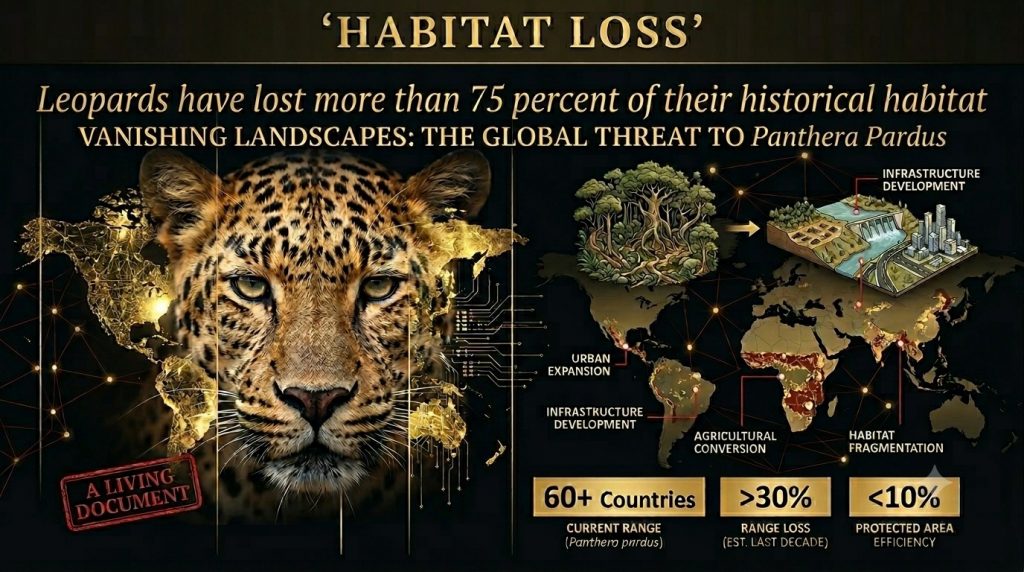
Habitat Loss Leopards have lost more than 75 percent of their historical habitat
Habitat — The Disappearing Landscape
What is being lost, where, and why it connects to everything else in this report
The Paradox of the Adaptable Species
The leopard is the most ecologically flexible large carnivore on earth. It persists in rainforests and deserts, farmland and mountain valleys, the edges of megacities and the high Himalaya. No other big cat has demonstrated this degree of tolerance for human-modified landscapes. It is, in measurable terms, built for coexistence.
While behavioural plasticity allows leopards to persist where other big cats often cannot, this adaptability and wide geographic distribution has not protected them against the multitude of threats they face. Leopards have suffered global range declines of 63–75%, exceeding the average 53% large carnivore range loss. Mongabay PeerJ-Zoological Science
The leopard’s adaptability is, paradoxically, part of its problem. The fact that it can survive near human settlements generates the conflict that kills it. The fact that it persists across fragmented landscapes creates the illusion of abundance that masks its actual decline. The species’ ability to persist in human-dominated landscapes has sometimes led to a misconception about their abundance, masking the severity of their overall population reduction. The leopard is disappearing — quietly, across a vast geography, in ways that seizure records and conflict incidents only partially capture.
The Numbers — Range Loss Across the Subspecies
The African leopard, which has the largest and most widespread population, is estimated to have declined by over 30% in the last 22 years. In West Africa, suitable leopard range has been reduced by more than 50% in the last two decades. Only an estimated 354 mature West African leopards remain — a 50% reduction across the region over the last three leopard generations.
For the Asian subspecies, the picture is starker. Suitable habitat remaining across historic range: the Persian leopard at approximately 16%, the North Chinese leopard at 2%, the Amur leopard — now one of the world’s rarest mammals — at 2% of historic range. The Indochinese leopard has been effectively extirpated from large parts of its former range. The Javan leopard survives on a single island with an estimated population of 320 individuals.
Due to habitat fragmentation and loss, the leopard’s range has reduced by 31% worldwide in the past three generations — approximately 22 years. These are not projected figures. They are documented reductions over a human lifetime.
The Drivers — What Is Removing the Habitat
Large carnivore populations are primarily threatened by habitat loss and fragmentation, exacerbated by prey depletion and persecution. These species are particularly vulnerable due to their wide roaming behaviour, which brings them into conflict with domestic livestock and humans.
The specific mechanisms operating across the leopard’s range are well documented.
Agricultural expansion is the dominant driver globally. West Africa has experienced rapid human population growth and, as a result, leopard habitats like savannas and forests are being cleared for agricultural fields and other development. In South and Southeast Asia, the conversion of forest to palm oil and rubber plantations has eliminated leopard habitat at scale — particularly in Malaysia and Indonesia where the Indochinese and Javan leopards have suffered their most severe losses.
Infrastructure development fragments what agriculture does not eliminate outright. Roads, hydropower projects, and urban expansion cut through movement corridors — the connective tissue between habitat patches without which isolated populations cannot maintain genetic diversity or recover from local depletion. Development projects spurred by mineral exploration, road and rail transportation networks, gas and oil pipelines, and hydro-electric power facilities have the potential to create a variety of negative impacts through fragmentation of large landscapes, creating barriers to movement, as well as mortality through road kills, pollution, disturbance, and poaching by construction workers.
Prey depletion is a compounding factor that receives less attention than direct habitat loss but is equally significant. A landscape without prey is not habitat, regardless of its physical character. The commercialised bushmeat trade has caused a collapse of prey populations across large parts of savanna Africa — an estimated average 59% decline in prey populations across 78 protected areas. Where prey is depleted, leopards turn to livestock — and conflict, retaliation killing, and the trafficking chain follow directly.
Tiger displacement is a South Asia-specific driver that is systematically underrecognised. As tiger populations recover in India’s protected forest cores — a genuine and celebrated conservation success — leopards are displaced into fringe zones, farms, and villages. The tiger recovery story has a structural shadow: it pushes leopards toward exactly the human-wildlife interface where conflict is inevitable, where snares are set, and where retaliation killing feeds the parts market. The two conservation stories — tiger recovery and leopard trafficking — are not separate. They are causally linked.
The Himalayan Corridor — Where Mission Leopard Operates
The Chitwan–Annapurna Landscape (CHAL) of Nepal represents one of the most important remaining leopard habitat corridors in Asia — and one of the most pressured. Leopard populations are isolated and dramatically reduced due to habitat fragmentation and loss, human-leopard conflict, and prey-based decline from their historic range.
A 2024 peer-reviewed study evaluating habitat connectivity between Chitwan National Park and Annapurna Conservation Area — precisely a corridor within which Mission Leopard’s LeopardEye deployments operate — found that leopards show better linkages among habitat patches than other large carnivores in the landscape, given their specific home range of 6–90 km², but that fragmentation and human activities including habitat loss, encroachment, and developmental activities such as roads, hydropower, and urbanisation are restricting animals’ movements and landscape connectivity.
The same study identified 15 habitat patches across the study area averaging 26.67 km² — each one an island of viable habitat in a sea of agricultural and human-modified land, connected to others only by increasingly narrow and compromised corridors.
Research published in January 2025 in the Annapurna Conservation Area added an important dimension: common leopards have an established residency at high altitudes traditionally associated with snow leopards — at 3,100–4,696m in the trans-Himalayan part of Annapurna Conservation Area — with evidence dating back to the 1950s. This is not a recent climate-driven incursion. Leopards have always occupied the high Himalaya. What is changing is the pressure on those high-altitude landscapes as climate alters prey distribution and human activity extends upward.
Climate Change — The Multiplier
Climate change is not the primary driver of leopard habitat loss. It is a multiplier operating on all the drivers documented above. A 2024 study using intraspecific species distribution models predicts changes in range suitability for leopard subspecies under future climate and land-use changes, identifying significant conservation gaps.
The directional effects vary by region. In Southeast Asia — already the most critically depleted leopard range — climate change is projected to cause up to 41% habitat loss across current and historical range, with a projected reduction of viable habitat patches by up to 23.29% in the future.
In contrast, the Himalayan arc — Nepal, Bhutan, and India — is projected to retain relatively higher connectivity. This regional disparity is significant for conservation prioritisation. The Himalayan corridor is not just where Mission Leopard currently operates — it is, according to the best available projections, one of the most resilient leopard habitats on a climate-altered planet but the threats are real, protecting it is not a local conservation task, it is a global one. Protect the Leopard to Protect the Himalaya
The Habitat-Trafficking Connection
This section belongs in Blood of the Leopard — not because habitat loss is primarily a trafficking story, but because the two crises are structurally connected in ways that conservation policy has been slow to address.
The mechanism is straightforward. Habitat loss and fragmentation push leopards into agricultural landscapes. Agricultural landscapes generate conflict. Conflict generates retaliation killing. Retaliation killing generates carcasses. Carcasses have market value. Market value generates trafficking. The leopard killed in a snare set at a forest edge in Kandhamal is not a different story from the leopard whose habitat was cleared for agriculture in the same district. They are the same story at different points in the same chain.
Large carnivore populations are particularly vulnerable due to their wide roaming behaviour, which brings them into conflict with domestic livestock and humans — and that conflict is intensifying precisely as habitat fragmentation reduces the buffer zones that once separated leopard territory from human settlement. The snare that kills a leopard in Karnataka is set at the edge of what used to be forest. The forest is gone. The leopard is there because it has nowhere else to go.
Addressing habitat loss is not separate from addressing leopard trafficking. It is the upstream intervention without which every downstream enforcement effort — every snare removal, every arrest, every prosecution — is working against an accelerating current.
What the Field Tells Us – Link to the Protect the Leopard to Protect the Himalaya Mission
Mission Leopard’s LeopardEye deployments in the Annapurna region are not only documenting wildlife presence. They are mapping the interface — the places where habitat ends and human landscape begins, where leopards move between the two, where the risks are highest and the data is thinnest.
Investigations conducted in the lower Annapurna confirmed what the research literature predicts: at the agricultural-forest boundary, the leopard is present, conflict is ongoing, snare pressure is real, and the communities living alongside these animals are struggling with the consequences of habitat compression. The leopard’s story at this interface is the coexistence paradox in its most immediate form.
What Mission Leopard is documenting in the Annapurna is what needs to be documented across the range — not as isolated data points but as a connected picture of a species under pressure across a disappearing landscape, whose fate is determined as much by what happens to the forests as by what happens in the courts.
Blood of the Leopard is a living document published by WildTiger / Mission Leopard. A comprehensive analysis of habitat across the full range will be included in the forthcoming regional companion reports.
wildleopard.net · wildtiger.org
