
Blood of the Leopard (BoL) – Living Intelligence Assessement and Blood of the Leopard (BoL) – Overview and Links to Sections.
The Bawaria Ghost Hunters of Big Cats
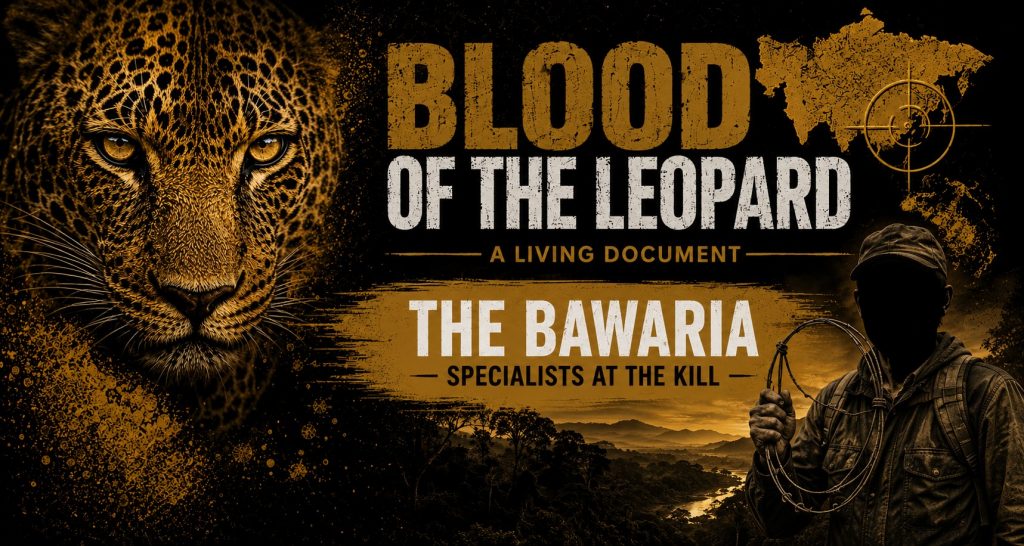
“The Bawaria have been called by anti-poaching teams, the ghost hunters of big cats”
Who the Bawaria Are
Understanding the leopard trafficking supply chain requires understanding who actually enters the forest, sets the trap, makes the kill, and processes the carcass. That person, across a vast portion of India’s leopard range, is frequently a member of the Bawaria community — and the relationship between this group, the big cat trade, and the organised criminal networks that profit from it is one of the most consequential and least discussed dimensions of wildlife trafficking in South Asia.
As per India’s 1881 census, the Bawariya community was labelled “a hunting community who derive their name from the word bawar or noose with which they snared wild animals.” Originally part of the Rajput clan, they are a semi-nomadic people spread across Rajasthan, Haryana, Punjab, Uttar Pradesh, and Uttarakhand — and, under the name Banjara or Banjura, across the border into Nepal.
In 1871, the British colonial administration notified them under the Criminal Tribes Act — effectively criminalising their traditional livelihood of hunting and marking them as hereditary criminals. The designation was abolished at Indian independence in 1947, replaced with “Scheduled Caste.” The structural marginalisation it encoded remained. No sustained education investment, no alternative livelihood pathways, no integration into the formal economy. The noose — the bawar — remained the instrument of survival.
What the colonial state created was a community with extraordinary tracking and hunting skills, a deeply embedded knowledge of forest systems, and no legal pathway to use those skills. What the wildlife trafficking networks found was a ready-made, economically desperate, institutionally invisible Tier 1 workforce.
What They Do — and How
The Bawaria are not the traders, the kingpins, or the buyers. They are the extractors — the people who enter the forest, locate the animal, set the kill, skin it, process the parts, and make the handover. Their value to trafficking networks is precisely their capability: tracking ability that wildlife investigators describe as among the finest in South Asia, ghost-like movement through terrain, capacity to live and operate in extreme jungle conditions for extended periods, and an intimate understanding of big cat behaviour and habitat.
Their modus operandi has evolved. For a long time they used heavy jaw traps — effective but bulky, leaving a detectable poaching footprint. They have since transitioned to high-tensile galvanised steel wire, set as strangle loops along animal trails. When a tiger or leopard steps through, the spring mechanism — a sapling, a bent branch — snaps taut, tightening the wire instantly around the neck or abdomen. The steel wire cuts deeper with every struggle. The death that follows — dehydration, infection, organ failure, blood loss — may take hours or days.
When the animal is confirmed dead, the Bawaria move in fast: skinning, extracting bones, claws, teeth, and any part carrying market value. The handover to organised crime intermediaries is precise and pre-arranged.
The snare here is not incidental. It is the Bawaria’s core tool — and it connects them directly to the #AntiSnare dimension of this report. The wire loop set in an Indian forest by a Bawaria poacher is the same instrument that kills leopards as bycatch across the range. The distinction between targeted poaching and opportunistic snaring collapses at the point where the carcass is processed and the parts enter the market.
The Cases — A Documented Pattern
The Bawaria’s operational footprint runs the length and breadth of India’s big cat range. The cases below represent documented, publicly confirmed enforcement actions — a fraction of actual activity.
Bhima Bawaria was convicted by a special environment court in Faridabad — responsible for killing over 30 tigers across India. Arrested in 2012 in a joint operation by Wildlife SOS, the Wildlife Crime Control Bureau, CBI, and the Haryana Forest Department. Tiger skeleton, tiger skin, ivory, and turtles recovered. He was identified as a supplier to international groups dealing in illegal wildlife organs, sentenced to three years and fined Rs 10,000. A repeat offender, first convicted in 2002.
Ranjit Singh Bawaria — described as a “legendary tiger poacher” and close aide of Sansar Chand, arrested in Melghat, Maharashtra in 2013. Convicted and died in prison. His son, Sonu Singh Bawaria, subsequently revived the network.
Sonu Singh Bawaria was arrested in February 2024 in Gadchiroli, with 13 members of his reconstituted network. An SIT investigation that followed established the full transnational reach of the operation: money flows tracked from a Myanmar-based kingpin through hawala agents to a local contact in Mizoram, who disbursed funds to poachers — including Sonu — via bank accounts, debit cards, and UPI payments. The same SIT report confirmed that the Bawaria and Pardhi communities’ members were jointly implicated with an accused Assam Rifles serviceman’s wife, who sold contraband to a Myanmar national. The leopard and tiger supply chain and the Myanmar distribution network — the same people, the same money flows.
Adin Singh alias Kalla Bawariya — convicted on 11 February 2026 at the Chief Judicial Magistrate Court in Narmadapuram, Madhya Pradesh. Four years rigorous imprisonment. Arrested in 2023 by the MP State Tiger Strike Force on specific intelligence. Investigations revealed cross-border links to Nepal and Maharashtra, and a broader network uncovered leading to two additional arrests. The case highlighted the inter-state and international dimensions of organised Bawaria-linked wildlife crime at the highest legal tier.
Sathyamangalam Tiger Reserve, Tamil Nadu — four Bawaria gang members arrested with a tiger skin, nails, and teeth, along with traps and barbed wire, after intelligence from local villages triggered a forest department operation. During the operation, the team found evidence that a leopard had also been trapped but abandoned — its skin damaged, rendering it commercially useless. Two criminal economies at work simultaneously: targeted big cat poaching and opportunistic leopard bycatch, the same trap, the same network.
The Network Connection
The Bawaria do not operate in isolation. An SIT report into the multi-state MP-to-Myanmar big cat trafficking case documented the involvement of both the Bawaria and Pardhi communities of northern and central India, finding that members of both “jointly poached numerous tigers from central India, south India, and the terai arc landscape.” The SIT traced payments from a Myanmar-based trafficker through hawala agents to a Mizoram contact, who disbursed funds directly to poachers including Sonu Singh Bawaria. The local tribal poacher and the transnational organised crime network are not separate systems. They are the same system, at different tiers.
The India-Nepal border is a primary operational zone. The Bawaria move across it with the same fluency they move through forest — and on the Nepal side, under their Banjara name, they connect with the same corridor that moves parts toward Tibet and China. Ramjas Banjara — arrested in Nepal with tiger hide and bones — represents this cross-border dimension precisely. The Adin Singh Kalla Bawariya conviction at Narmadapuram in 2026 explicitly flagged Nepal links in the investigation. The network is not bounded by national borders. Neither are the Bawaria.
The Structural Argument
The Bawaria are not the cause of leopard trafficking. They are its most visible, most arrested, and least consequentially punished tier. The kingpins who contract their services — who pay Rs 50,000 for a leopard skin that will sell for many multiples of that at destination — rarely face arrest. When they do, they post bail. The Bawaria poacher who makes the kill and receives a fraction of the value faces the full weight of whatever enforcement exists. The sentence, when it comes, is typically the minimum.
This structural inversion — maximum prosecution risk at the bottom of the supply chain, near-impunity at the top — is not specific to the Bawaria. It is the defining characteristic of wildlife trafficking enforcement globally. But the Bawaria case makes it unusually visible, because their community’s history places the question of culpability in an uncomfortable light.
A people criminalised by colonial law for their hunting skills, denied alternative livelihoods for 150 years, and now prosecuted for the skills the state first criminalised and then never replaced — the moral complexity is real, and it does not make the leopards they kill any less dead.
Addressing the Bawaria dimension of leopard trafficking means addressing the enforcement gap at the top of the network — the kingpins, the buyers, the destination market regulators — at least as vigorously as the poachers at the bottom. It also means genuine livelihood investment in the communities from which the Tier 1 workforce is drawn. Without both, the forest continues to serve as what one investigator described as a “bank account” — and the Bawaria, or whoever fills their role, will continue to make the withdrawals.
Blood of the Leopard is a living document published by WildTiger/Mission Leopard
wildleopard.net · wildtiger.org
