Blood of the Leopard (BoL) – Living Intelligence Assessement and Blood of the Leopard (BoL) – Overview and Links to Sections.
Crime Convergence Wildlife trafficking and the broader criminal ecosystem
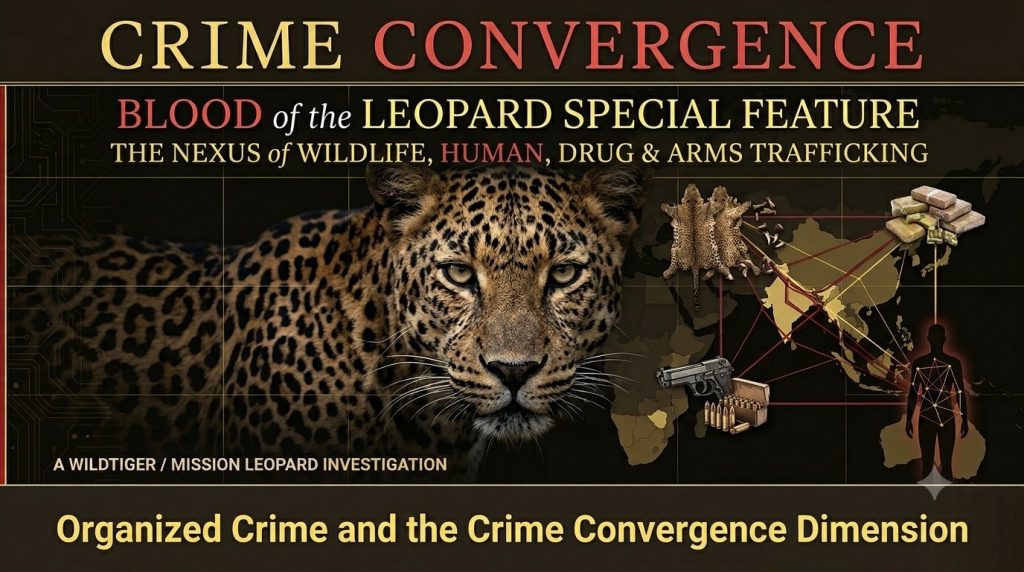
Please note – The links between wildlife and human trafficking are currently being further explored. This page will be updated when the initial phase of that investigation is complete.
Not a Separate Crime
Wildlife trafficking does not exist in isolation. It shares infrastructure, personnel, routes, financing, and methods with some of the most destructive criminal enterprises on earth. The networks that move leopard skins from Indian forests to destination markets are, in many cases, the same networks that move narcotics, weapons, and human beings. This convergence is no longer a theory advanced by conservation organisations. It is empirically confirmed, documented in peer-reviewed research, and visible in specific, named cases across the range states where leopard trafficking is most active.
Understanding crime convergence is not an academic exercise. It has direct implications for how wildlife trafficking is classified, resourced, and prosecuted — and for why the enforcement gap documented elsewhere in this report is so persistent. When wildlife crime is treated as a niche environmental offence rather than as a node in a transnational organised crime network, the response is proportionate to the former. The scale of the problem demands a response proportionate to the latter.
The Evidence Base
Research published in 2025, drawing on more than 100 interviews with investigators in Canada, South Africa, and Hong Kong, confirms that wildlife trafficking is rarely isolated. Whether in South Africa’s rhino reserves, Hong Kong’s shipping terminals, or Canada’s coastal towns, the same pattern repeats: the people and networks trading in wildlife are also frequently involved in other forms of criminal activity.
Converging crimes include trafficking in drugs, arms, persons, body parts, and mined goods. Convergence may involve bartering, product convergence, and forced criminality. Drug trafficking was the type of organised crime most frequently reported by investigators to converge with illegal wildlife trade.
The mechanism is logical. Organised crime networks first became successful in drug trafficking before diversifying or transitioning into wildlife trafficking. The apparatus — corruption networks, border crossing methods, money laundering infrastructure, courier systems — transfers directly from one trade to another. Wildlife parts, in many jurisdictions, carry significantly lower legal risk than narcotics while generating comparable profit margins. The rational criminal diversifies.
The barter dimension of crime convergence deserves particular attention. In documented cases across multiple jurisdictions, wildlife has functioned as direct criminal currency — abalone traded for methamphetamine, sturgeon exchanged for heroin, rare species bartered for weapons. Drug traffickers have been found protecting narcotics consignments with illegally held lions and tigers, and using illegal firearms to poach animals whose parts then fund further operations. These are not isolated incidents. They represent a fungible criminal marketplace in which wildlife parts, narcotics, weapons, and cash move interchangeably through the same networks. The leopard skin is not merely a wildlife product in this economy. It is a unit of exchange.
The South Africa Case — Opium in the Lion Bones
The convergence is not always abstract. In 2021, investigators in South Africa raided a Vietnamese organised crime ring operating out of a local farm. They found more than 800 pounds of lion “cake” — a traditional medicine product made by boiling lion bones. They also found 13 gallons of opium that the suspects had been adding to their lion cake.
Wildlife products literally adulterated with narcotics. The two trades — big cat parts and opiates — physically merged in a single product, operated by a single criminal network. This is not convergence as metaphor. It is convergence as chemistry.
Myanmar and the Golden Triangle — The Convergence Hub
Nowhere is crime convergence more visible, more documented, or more directly relevant to leopard trafficking than in Myanmar’s border zones and the broader Golden Triangle region.
Myanmar’s Shan State and Laos’s Bokeo province have emerged as a contiguous zone of vibrant criminality. Unregulated casinos, money laundering, drug production and trafficking, online scamming operations, and illegal wildlife trade all thrive — entrenching corruption, weakening governance, and damaging the bonds that create community.
Leopard parts are explicitly named in this market. In Mong La — a town on Myanmar’s border with China that began as a drug trafficking and gambling hub — visitors can openly buy endangered species products including tigers, leopards, elephants, rhinos, and pangolins, all smuggled in from Asia and Africa. The same infrastructure that moves drugs moves wildlife. The same networks that run casinos run trafficking corridors.
The scam compound dimension adds a further layer. The Zhao Wei crime network — sanctioned by the US Treasury since 2018 — engages in drug trafficking, human trafficking, child prostitution, and wildlife trafficking, all facilitated through the Kings Romans Casino. A single named actor operating across all four trades simultaneously. “Cyber-scam operations exemplify a convergence of various forms of transnational organised crime on a large scale,” according to a May 2025 report from the Global Initiative against Transnational Organised Crime.
This is the environment through which leopard parts — sourced in India, consolidated in Nepal, moved through Tibet, Bangladesh and Myanmar — reach their destination markets. The trafficking corridor does not operate in a clean, single-commodity pipeline. It moves through a criminal ecosystem in which everything is connected.
Weapons and Wildlife — Indonesia, June 2024
Indonesian police seized weapons and ammunition from an alleged trafficking network whose suspects had sold over 100 endangered birds in the Philippines and used the profits to buy M16s and a shotgun. What is unique about this case is the convergence of two criminal economies — wildlife trafficking and arms dealing — in a single operation.
The logic: wildlife trafficking generates cash in markets where weapons are scarce. Arms trafficking generates weapons in markets where wildlife parts are available. Barter between the two criminal economies, across borders, through networks already established for one trade, serves both.
The Cali Cartel Connection
A Mongabay investigation in Colombia revealed that the owner of a massive haul of shark fins seized in 2021 was the son of a leader of the Cali Cartel — one of the world’s largest drug-trafficking organisations. The world’s most sophisticated drug trafficking infrastructure, applied to wildlife parts. The financial flows, the corruption networks, the border crossing methods — all transferable, all transferred.
The Field Evidence — Berhampur, India, May 2026
Mission Leopard’s own field documentation provides a direct and recent example of crime convergence in the leopard trafficking context. In May 2026, a leopard skin was seized in Berhampur, Odisha — transported alongside live bombs, a sword, an iron rod, and a knife. Three suspects were arrested after a chase through forest in which one brandished a sword at officers. A fourth escaped carrying a firearm.
A leopard skin and live ordnance in the same vehicle. This is not a coincidence of packing. It is an illustration of the broader criminal ecosystem from which leopard trafficking cannot be separated. The networks that move skins move weapons. The people who carry skins carry arms. Treating leopard trafficking as an isolated wildlife crime — as most enforcement frameworks do — misses this reality entirely.
Operation Thunder — Leopard Parts and Mixed Contraband
The convergence of leopard trafficking with broader criminal activity is not only documented in field intelligence. It appears consistently in the findings of INTERPOL’s Operation Thunder series — the largest coordinated global enforcement operations against wildlife and forestry crime ever conducted.
During Operation Thunder 2024, which ran from November to December and involved law enforcement from 138 countries, a leopard hide was seized in Namibia and a leopard skin coat was discovered in Poland — transported alongside 300 seahorse tablets. A single shipment. Multiple species. Multiple products. A single criminal movement across international borders.
In Operation Thunder 2025, South African authorities arrested 24 suspects in a single operation, seizing protected wildlife species alongside unlicensed firearms and ammunition. The remains of a snow leopard were seized in a separate action during the same operation period.
The pattern is consistent across both editions: wildlife contraband — including big cat parts — moves alongside other illegal goods through the same networks, in the same shipments, handled by the same people. This is not coincidence. It is the operational logic of criminal diversification.
Wildlife and Human Trafficking — The Connection Confirmed
The links between wildlife trafficking and human trafficking are no longer a matter of investigation. They are a matter of documented record.
Peer-reviewed research published in October 2025 in the Journal of Economic Criminology — drawing on 112 interviews with law enforcement personnel across South Africa, Hong Kong, and Canada — found evidence of illegal wildlife trade converging with drug trafficking, sex trafficking, child abuse, trafficking in human body parts, migrant smuggling, forced and bonded labour, illegal alcohol trade, arms trafficking, vehicle theft, counterfeit goods, and illegal mining. The lead researchers concluded that convergence is the norm rather than the exception — its specific form depending on the species, location, organised crime group, and stage of the supply chain.
The forced labour dimension is particularly documented. Criminal networks have been found exploiting people through forced labour to extract wildlife products from the field — a practice recorded in connection with rhino horn, marine species, and forest products. In Canada, investigators documented migrant workers being illegally exploited in wildlife processing facilities. In some criminal circles, researchers found that the line between wildlife trafficking and the illegal trade in human remains can blur entirely — both handled by the same networks, through the same channels.
The Malaysia-Vietnam tiger trafficking corridor provides a direct big cat example. Research published in January 2025 documented instances of forced labour and child labour on fishing vessels operating in Malaysian territorial waters — the same vessels used to transport people and wildlife products simultaneously. Human trafficking and wildlife trafficking, on the same boat, in the same journey.
The barter economy that connects these trades makes the convergence concrete. In documented cases, wildlife has been used as direct currency for narcotics — abalone traded for methamphetamine, sturgeon exchanged for heroin. Drug traffickers have been found protecting narcotics stashes with illegally held lions or tigers. Illegal arms have been used to poach animals whose parts then fund further criminal operations. The boundaries between these criminal economies are, in practice, largely administrative.
**Operation Sandokan — The Lower Mekong’s Biggest Wildlife Traffickers**
In June 2026, Earth League International (ELI) released Operation Sandokan: Unmasking the Lower Mekong’s Biggest Wildlife Traffickers — the most extensive undercover investigation into the illegal wildlife trade ever conducted in Cambodia. Produced after more than a year of sustained undercover intelligence operations inside active trafficking networks, it is the most current and comprehensive documentation of crime convergence in Southeast Asia’s wildlife trade, and its findings directly extend and validate what Blood of the Leopard has documented.
ELI’s field teams operated inside active criminal networks — sitting across from kingpins, smugglers, logistics facilitators, and their political enablers. They witnessed endangered species slaughtered on demand at exclusive restaurants. They heard traffickers name their political protectors as casually as they quoted prices.
The convergence findings are unambiguous. Among ELI’s persons of interest, criminal activities extended well beyond wildlife: drug trafficking, timber trafficking, prostitution with the potential to be human trafficking, the smuggling of counterfeit goods, and money laundering. Two primary persons of interest — designated Cam1 and Cam2 — are described as the largest wildlife traffickers ELI has encountered to date, and contenders for the biggest in the entire Lower Mekong. Their supply chains reach Africa, Europe, Russia, and South Asia. Cam1 described their supply as “endless.”
The scam compound connection — documented in our earlier section on Myanmar — is now confirmed in Cambodia. The domestic illegal wildlife trade within Cambodia was largely bankrolled by the wealthy bosses of scam compounds, primarily owned and operated by Chinese nationals. One ELI person of interest estimated their spending on wildlife products at USD 500,000 a month at a single business. Exclusive clubs and restaurants catered to corrupt elites with exotic species slaughtered on demand on the premises. Illegal wildlife shopping tours were organised for a clientele that ELI sources described as predominantly Chinese government officials or employees of state-owned companies.
The adaptive nature of these networks is itself a finding. Following crackdowns on the Cambodian scam industry in late 2025, surviving criminal groups broke into smaller cells and relocated — to Burma, Laos, and as far as Sri Lanka. Laos, with its high-speed rail connection to China and its environment of consolidated family-based political control, has emerged as the next hub. The network does not dissolve under pressure. It disperses and reconstitutes.
ELI found high levels of collusion between Chinese criminal networks and Cambodian political and business elites. Persons of interest were photographed with high-ranking national and local politicians. They operated nine shops throughout Cambodia openly — an indicator of the protection they had secured. The report’s conclusion is direct: state capture and embedded corruption are prohibitive to effectively combatting transnational organised crime from within these countries. External action is required.
Operation Sandokan is available in full at earthleagueinternational.org. Confidential Intelligence Briefs from the investigation have been shared with U.S. law enforcement partners and are informing active investigations.
*Source: ELI, Operation Sandokan: Unmasking the Lower Mekong’s Biggest Wildlife Traffickers, June 2026.*
Mission Leopard is continuing to investigate the specific connections between leopard trafficking and human trafficking networks across the South Asia corridor. This section will be updated as that investigation develops.
What Crime Convergence Means for Enforcement
The convergence has direct implications for how the trade is fought.
First, it means wildlife trafficking intelligence is organised crime intelligence. Information about leopard trafficking networks is information about drug networks, arms networks, and human trafficking networks. The intelligence value of a wildlife trafficking investigation exceeds the wildlife crime itself — and should be resourced accordingly.
Second, it means enforcement frameworks designed for single-commodity crime are structurally inadequate. An agency that treats a leopard skin seizure as a wildlife case and a narcotics seizure as a drugs case — when both involve the same network — is investigating half the picture twice.
Third, it means the financial flows that sustain leopard trafficking are the same flows that sustain some of the most harmful criminal enterprises operating today. Following the money from a leopard skin seizure in Odisha does not lead to a wildlife trader. It leads to a network. That network may have fingers in drugs, arms, human trafficking, and cyber fraud. The leopard skin is the entry point.
Criminal organisations traditionally involved in drug, weapons, and human trafficking are increasingly shifting focus to illegal logging, wildlife trafficking, and the extraction and trade of valuable resources. Wildlife trafficking and illegal resource trade drive global crime, damage ecosystems, and threaten climate, food, and economic security.
The leopard’s crisis is not separate from the world’s other crises. It is woven into them. Addressing it requires seeing that connection clearly — and building enforcement, intelligence, and policy responses that match the full scope of what is actually happening.
Blood of the Leopard is a living document published by WildTiger / Mission Leopard. This page will be updated as new intelligence and research becomes available.
wildleopard.net · wildtiger.org
