
Blood of the Leopard (BoL)
Blood of the Leopard is Mission Leopard’s living intelligence publication – the evidence: investigations, intelligence, trafficking, analysis, and the living record of illegal wildlife trade.
Continue on this page for overviews which link to BoL sections and dimensions . Quick links to sections are in the index below and also at the Site Map at the bottom of each page where you can also find other elements of Mission Leopard including the flagship mission, Protect the Leopard to Protect the Himalaya and a key to our philosophical approach – Spirit of the Wild
BoL Section – The Trafficking Network
BoL Section – Crime Convergence
BoL Section – The Bawaria: Ghost Hunters of Big Cats
BoL Section – The Enforcement Gap
BoL Section – The Scale of the Trade
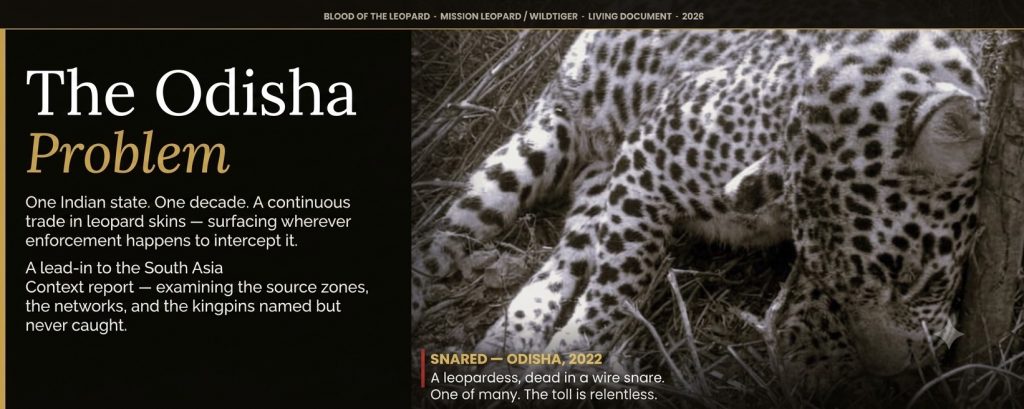
BoL Section – The Odisha Problem, A Regional Example
BoL Section – The Leopard and Traditional Medicine
BoL Section – The Online Marketplace
BoL Section – The Snare: Entry Point to the Supply Chain
BoL Section – The Coexistence Paradox
BoL Section – Trophy Hunting: ‘Legal’ Killing of Leopards
BoL Section – Asia Intelligence Context
BoL Section – Africa: The Continental Killing Fields
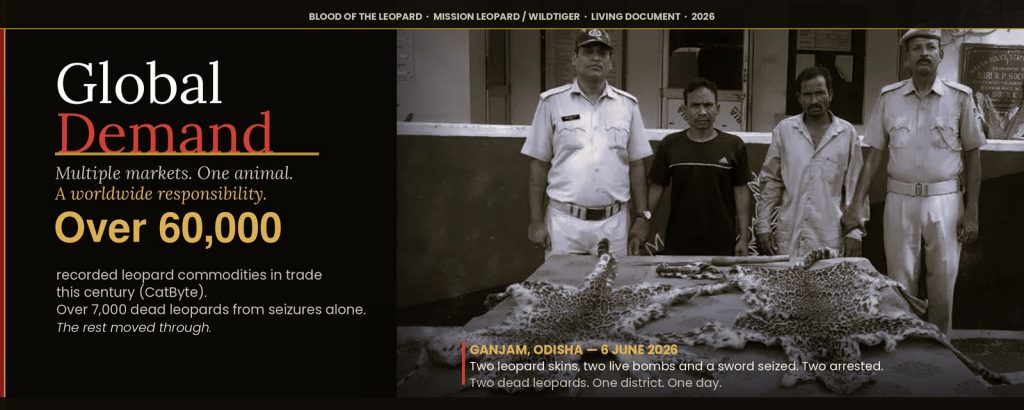
Blood of the Leopard is a living document. Latest releases (please read Global Demand) are shown here as sections are published. Please read below for overviews and links to initial sections and dimensions.
New Section: ASIA INTELLIGENCE CONTEXT
Understanding the Asian Leopard Trade as One Connected System
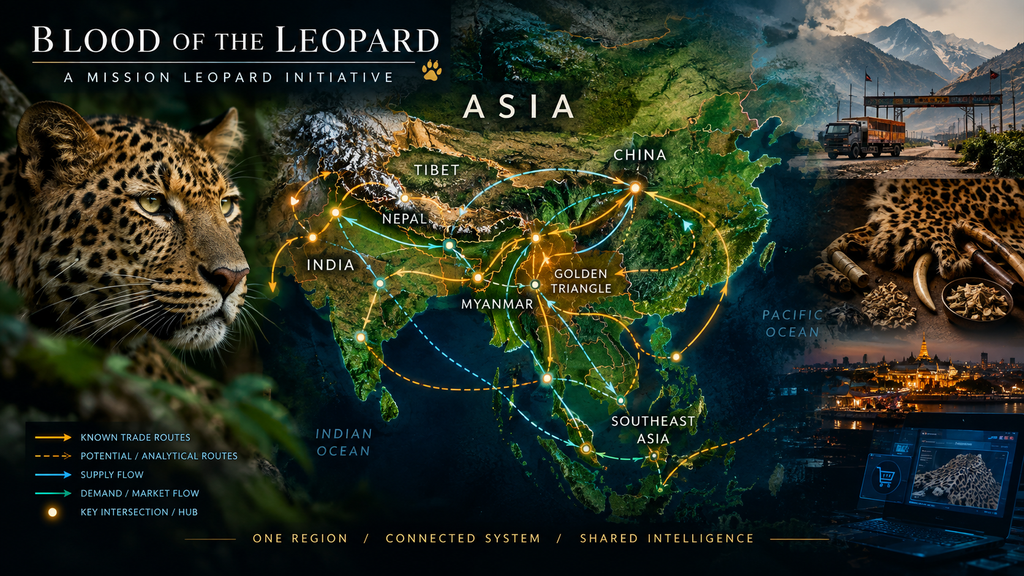
Blood of the Leopard is now developing a single Asia Intelligence Assessment, bringing South and Southeast Asia together within one regional intelligence framework – Read the Initial Section Release HERE
New Section: SNARED – THE INDOCHINESE LEOPARD
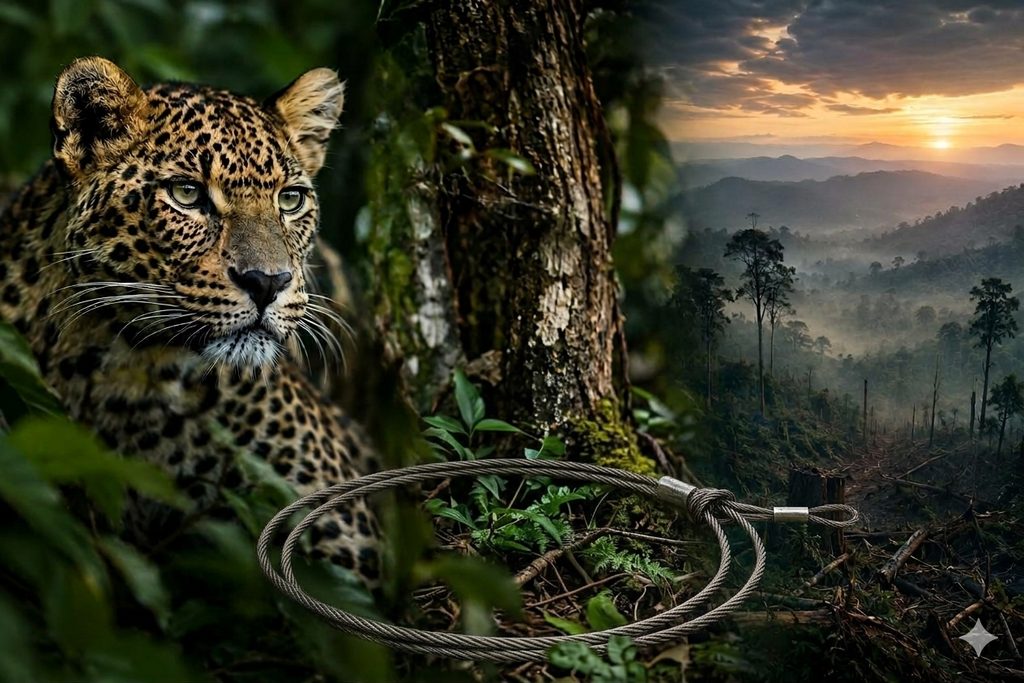
“The authors concluded that the Indochinese leopard now appears to have been extirpated from Cambodia, Laos and Vietnam.“
Behind that disappearance is a story of relentless snaring.
SNARED – THE INDOCHINESE LEOPARD: Full Section HERE
New Section: The Killing of Leopards through Trophy Hunting deemed LEGAL
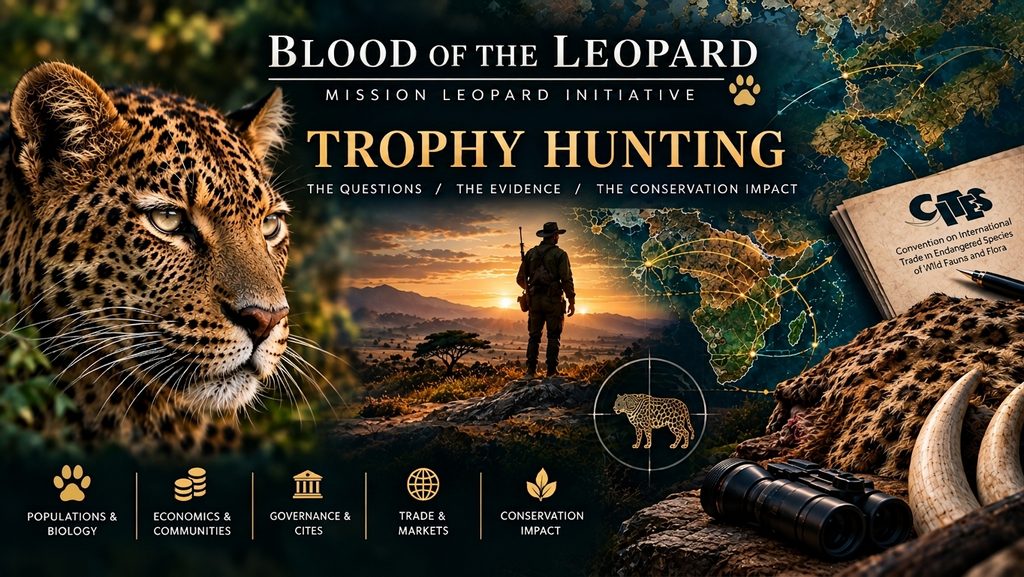
Understanding the killing of leopards for sport, the systems that permit it, and the conservation questions that remain. Read the preliminary section HERE.
Recent Releases: The Odisha Problem
Latest Releases – Updated September 2026 The Online Market Place:
The global epicenter of the modern illegal wildlife trade isn’t hidden in a back-alley bazaar or tucked away on the dark web—it is operating completely in plain sight right in our pockets. This section exposes how mainstream social media platforms and their engagement-driven algorithms have built the most efficient black-market network in human history. Instead of acting as passive hosts, these systems actively recommend illicit wildlife profiles, network poachers directly with buyers, and even monetize poaching content under the shield of outdated digital immunity laws. From open-air digital menus offering critically endangered species to the logistical coordination of massive transnational smuggling operations, we unpack how everyday code is accelerating real-world ecological collapse—and how we can fight back to disrupt this digital supply chain. Read the latest updated full section HERE.

Latest Releases: Africa
“Traffickers are usually doing leopard skins; it’s good business for them … I definitely see an increase in it.”
— Ofir Drori, Founder, EAGLE Network
The African leopard is being traded at an alarming rate, not just for its bones destined for traditional medicine, but for its skin—a symbol of status, power, and tradition across the continent. While the iconic spots of the leopard have long been a ceremonial emblem for royalty and religious groups, the commercial demand is now driving a surge in trafficking that threatens the species’ very survival. Ofir Drori, whose EAGLE Network conducts undercover sting operations across nine African countries, notes that his teams successfully seize around 30 leopard skins per year. Yet, he is the first to admit this represents only a “tiny fraction” of the actual trade flowing through vast, underground markets. This section of Blood of the Leopard investigates the scale, routes, and drivers of the leopard trade in Africa, highlighting the fight to enforce the law in the face of corruption and growing demand.
The Section: Africa’s Leopard Trade
Continue reading below the Blood of the Leopard Overview and links to further sections and dimensions:
The Neglected Crisis
The leopard (Panthera pardus) occupies a range no other wild felid can match – from the rainforests of West Africa to the high Himalayan valleys of Nepal, from the Russian Far East to the Arabian Peninsula. In more than 60 countries, the leopard still persists. It is adaptable, cryptic, and resilient. It is also being systematically killed for trade, at a scale that conservation science and enforcement agencies have been slow to reckon with.
The reason is not obscurity. The leopard is one of the most recognisable animals on the planet. The reason is hierarchy. In the political economy of wildlife conservation, tigers, rhinos, and elephants command the funding, the enforcement attention, the diplomatic capital. The leopard — despite being killed in greater numbers, across a wider geography, with less legal consequence — sits in their shadow.
This report exists because that hierarchy is killing leopards at a rate the available data only partially captures, and because the neglect is systemic, not incidental. The leopard is the flagship for the forgotten — the most traded and least prioritised of the species that fall outside conservation’s narrow A-list.
“His name appeared in every major seizure. In every trafficking network. Across India, Nepal, Tibet, and China. And yet the courts let him walk.” — Nepal CIB officer in reference to Nepali wildlife trafficker Lodu Dime
About this report – A Living Document
Blood of the Leopard is the first report published under the Mission Leopard programme of WildTiger (wildtiger.org). It is a living document — updated as new field intelligence, seizure data, and case outcomes become available.
A Note on Scope — and What Comes Next
This initial publication of Blood of the Leopard focuses primarily on South Asia — the India-Nepal-Tibet-China corridor that represents the most documented and most active leopard trafficking route on earth. That focus reflects the depth of field intelligence currently available, the location of Mission Leopard’s operational deployments, and the density of case material that makes the South Asian picture the clearest starting point for a global argument. A companion report, Blood of the Leopard: South Asia Context, will follow shortly, providing granular district-level analysis of the trafficking and conflict situation across Nepal, India, and the broader Himalayan arc.
But the leopard’s crisis is not a South Asian crisis. It is a planetary one. Panthera pardus is recognised across nine subspecies, distributed from the West African rainforest to the Russian Far East, from the Arabian Peninsula to the Cape. In each of those landscapes, the leopard faces a version of the same threat — illegal killing, parts trade, and the systematic neglect of a species that falls outside conservation’s narrow hierarchy of attention. The African leopard is being traded openly in markets across West and Central Africa and exported to collectors in the Middle East and Europe. The Amur leopard — with fewer than 100 individuals remaining in the wild — faces poaching pressure that a population of that size cannot absorb. The Persian leopard, the Javan leopard, the Arabian leopard — each has its own trafficking dynamic, its own enforcement failure, its own data gap. Southeast Asia presents its own distinct and deeply troubling picture: the Indochinese leopard has been effectively extirpated from large parts of its former range, and what remains is under sustained pressure from a regional wildlife trade infrastructure that is among the most sophisticated and least prosecuted on earth.
Dedicated companion reports on both South Asia and Southeast Asia are in active development and will be published as the next stages of this living document. Broader coverage of Africa, the Russian Far East, and the remaining range states is being assembled and will follow. Blood of the Leopard will document all of it. If you have intelligence, case data, or field evidence relevant to leopard trafficking in any range state, we want to hear from you — through wildleopard.net or wildtiger.org.
Ongoing investigation
This report focuses on the illegal trade in leopard body parts. Active field research, LeopardEye monitoring deployments, and partnership investigations are underway. Key sections — including the China leopard bone loophole — will be substantially expanded as new intelligence is confirmed.
The Trafficking Network
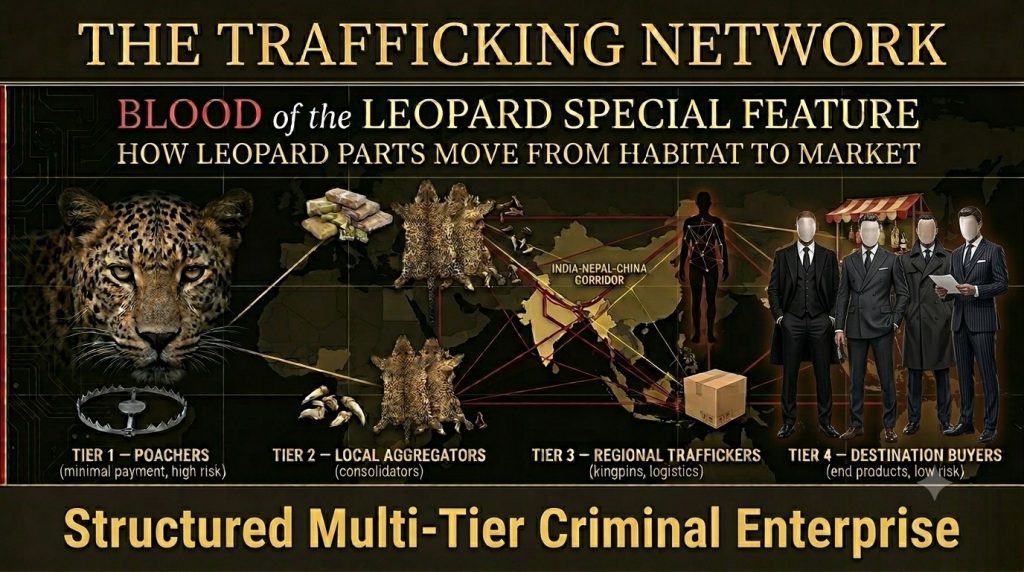
The illegal leopard trade is a four-tier criminal enterprise that operates across dozens of countries with the efficiency of a logistics company and the impunity of an institution that has correctly calculated its legal risk. At the base: forest-level poachers, often from marginalised communities with no economic alternative, who kill and skin for a fraction of the parts’ final value. Above them: local aggregators who consolidate and move. Above them: regional kingpins — Sansar Chand, Kunjoc Lama, Yangchen Lachungpa — who coordinate across borders and rarely touch the contraband. At the apex: destination market buyers in China, Vietnam, the Middle East, and Europe, who convert parts into products and bear virtually no legal consequence whatsoever.
This structure is not incidental. It is deliberately designed so that the people who carry the highest enforcement risk — the poachers — are the people with the least information about the network above them, and the people with the most information — the kingpins — are the hardest to arrest and the most likely to walk free when they are.
Full section: The Trafficking Network
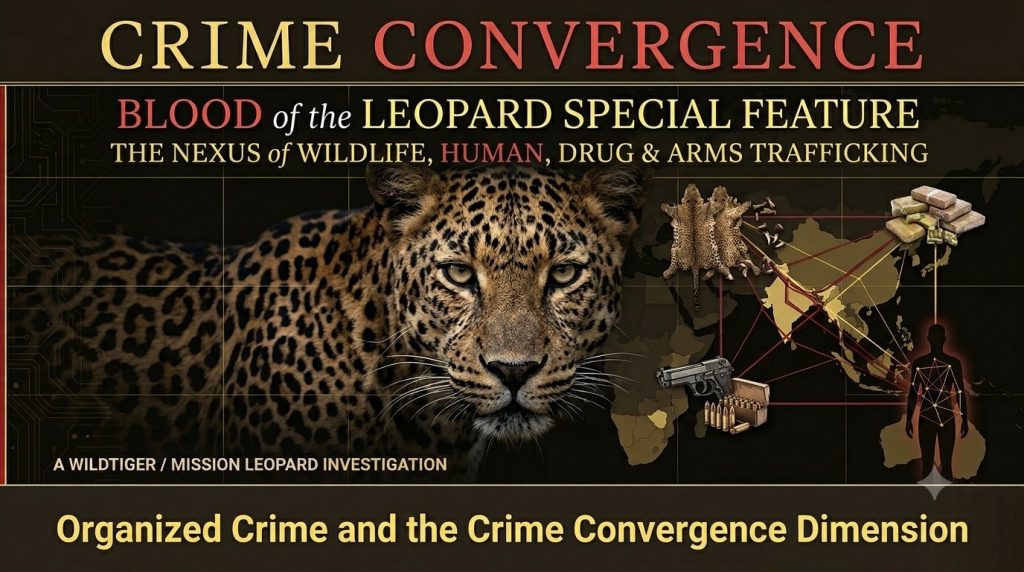
Crime Convergence Wildlife trafficking and the broader criminal ecosystem
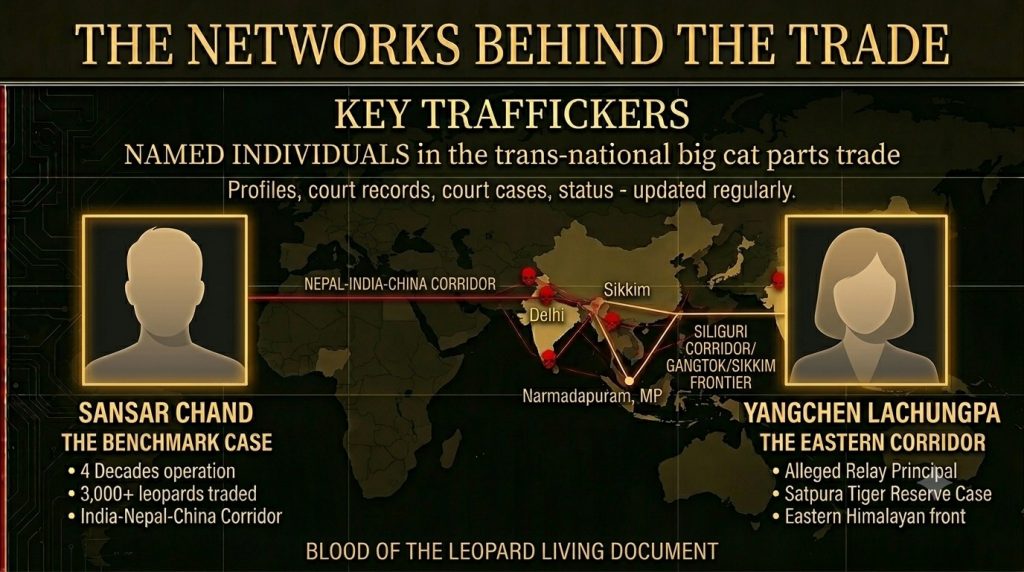
Story of a Kingpin: Sansar Chand – A lead in to Key Traffickers
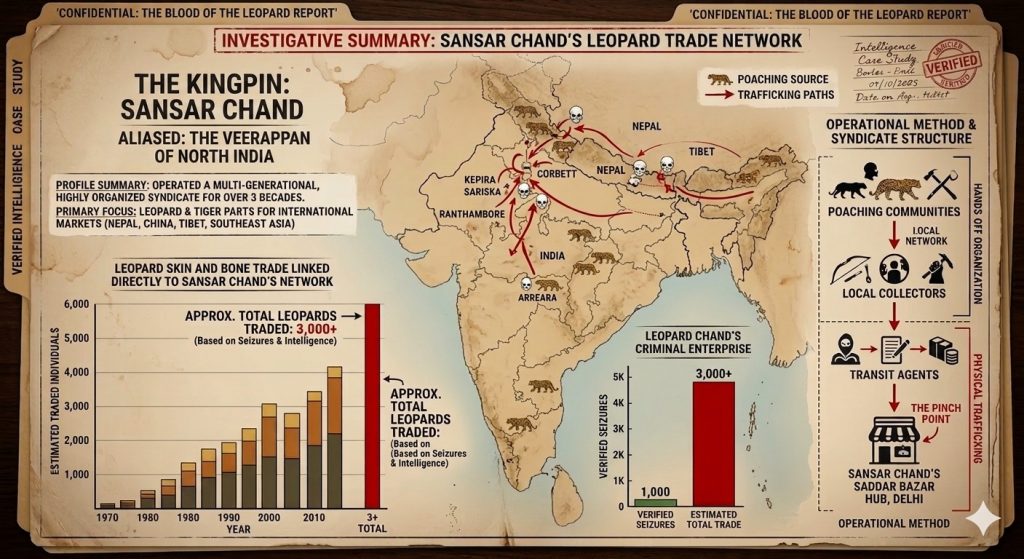
Understanding wildlife trafficking as an abstraction obscures the human architecture that makes it possible. Sansar Chand is not a historical footnote. He is the clearest documented case of what the leopard trafficking network looks like from inside — and of what happens when enforcement systems fail to match the scale of the crime.
Intelligence Case Study — Sansar Chand’s Leopard Trade Network · Source: Mission Leopard analysis
In four decades of operation, Sansar Chand became the most documented wildlife trafficker in Indian history. Of every animal whose death can be attributed to his network, the leopard accounts for the vast majority. During CBI interrogation in 2006, Chand admitted to selling 470 tiger skins and 2,130 leopard skins to just four clients from Nepal and Tibet. That single confession — to four buyers — plus further investigation places an estimated 3000 leopards as the minimum attributable to his network from admitted sales alone.
Diaries seized from Chand’s family by the Rajasthan Police in 2004 showed transactions of 40 tiger skins and 400 leopard skins in just 11 months — October 2003 to September 2004. More than one leopard killed every day, for nearly a year, from a single network.
Across four decades of operation, Chand and his network killed more than 200 tigers and those estimated 3,000 leopards, along with 5,000 otters, 20,000 wild cats, 20,000 wild foxes, and numerous other animals. When asked about the total, Chand was reportedly unapologetic: the number of animals he killed was, he said, uncountable.
He was first arrested at age 16, in September 1974, in a case involving tiger and leopard skins and 676 other wildlife skins. He was convicted 15 times of wildlife offences before serving any significant prison sentence. He faced at least 100 court cases across nine states. He eluded punishment even after being caught with 28,486 contraband pelts in 1988.
Chand died in Tihar Jail in 2014 — of lung cancer — while still facing trial for the Sariska poaching. He never served a sentence proportionate to 2,130 documented leopard skins. The network he built did not die with him. It adapted. The names changed. The mechanisms did not.
“Sansar Chand is primarily responsible for the disappearance of tigers from Sariska Tiger Reserve. He reputedly poached the last tigers there as an act of vengeance.” – Wildlife Protection Society of India
“Sansar Chand as a trafficker of leopard body parts set precedents that still exist today. His death has not stopped that of hundreds and hundreds of leopards due to poaching and trafficking.” – Jack Kinross, WildTiger coordinator
Please click on the image below to find information on key traffickers as we add them to the living document. The first addition is Yangchen Lachungpa.
The Bawaria — Specialists at the Kill
The Bawaria community were labelled a “criminal tribe” by British colonial law in 1871 — criminalised for the hunting skills their survival depended on, denied alternative livelihoods for 150 years, and now prosecuted for those same skills at the lowest tier of a supply chain whose upper tiers face near-impunity. Their tracking ability, forest knowledge, and capacity to operate invisibly in extreme terrain make them the most effective Tier 1 workforce available to trafficking networks across India and Nepal.
Understanding the Bawaria is not a separate issue from understanding leopard trafficking. It is a precise illustration of how the enforcement paradigm fails — maximum legal pressure at the bottom of the network, minimum at the top — and of why addressing the trade requires addressing its structural economics as much as its criminal law.
Full section: The Bawaria – Specialists at the Kill

Blood of the Leopard – Ongoing Sections, the Living Document at work
Scale of the Trade
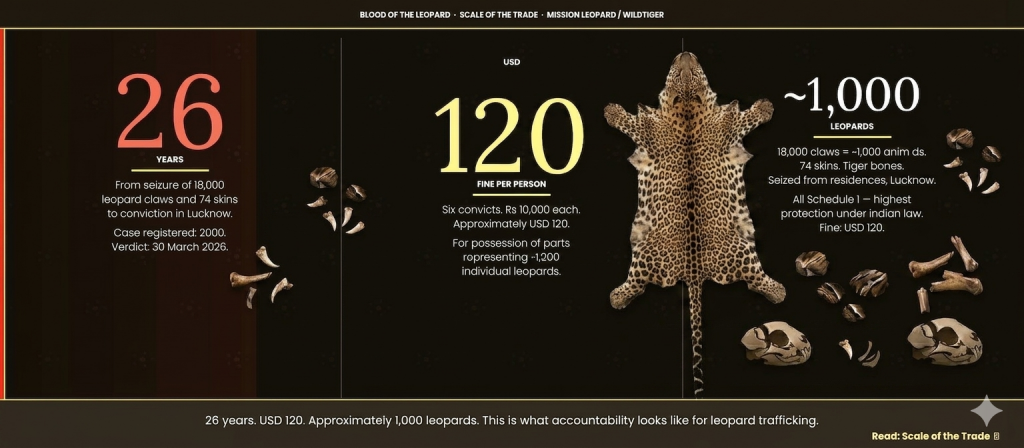
26 years. USD 120. Approximately 1,000 leopards dead.
In March 2026, a Lucknow court convicted six people for possessing 18,000 leopard claws and 74 leopard skins. The fine was Rs 10,000 each. The case had been registered in 2000. This is what accountability looks like for leopard trafficking.
Read the Full Section – Scale of the Trade
The Coexistence Paradox When living with leopards becomes a death sentence — for people and the species
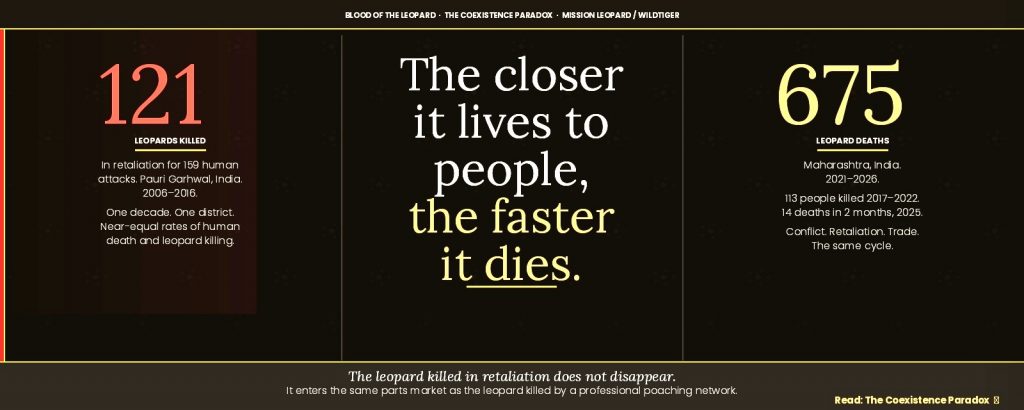
The leopard is the only big cat that has genuinely learned to live alongside human beings. It inhabits sugarcane fields and tea gardens, the edges of megacities and mountain villages, agricultural land and temple forests. No other large predator has demonstrated this degree of ecological flexibility. It is, in every measurable sense, a species adapted for coexistence.
That adaptability is now killing it. Read More.
Key Issues: The Full Picture
Wildlife crime is rarely understood as a system. It is reported as individual incidents — a seizure here, an arrest there, a species listed as endangered somewhere else. The cumulative picture, the architecture that connects these incidents into a single functioning enterprise, rarely receives the attention it demands.
Blood of the Leopard is built around interconnected dimensions of the leopard trafficking crisis. They are presented separately because each requires its own evidence base, its own case studies, its own documentation. But they are not separate problems. They are the same problem, viewed from different angles — and the solution to any one of them requires understanding all the others. Below we begin to examine different dimensions, we will be enlarging on each and adding more as part of the living document format.
The Snare — Entry Point to the Supply Chain
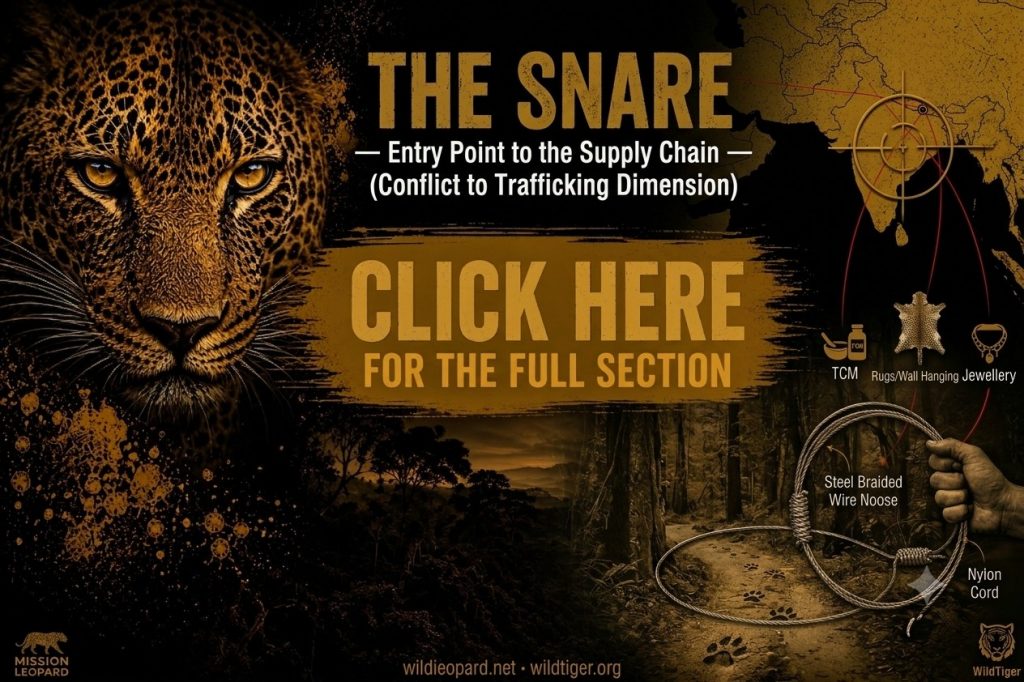
A wire loop set for a barking deer kills a leopard with equal efficiency. The snare does not distinguish between targeted poaching and incidental bycatch. The leopard that dies in a snare — whether a professional poacher set it or a subsistence farmer trying to protect his crops — enters the same parts market as one killed by a dedicated network. The snare is the point at which opportunistic killing and organised trafficking converge.
WildTiger’s #AntiSnare campaign exists because this connection is real and documented. More than 40 million snares are set annually in Central Africa alone. 93% of documented leopard snaring occurs outside protected areas, at the agricultural-forest interface where patrol infrastructure is minimal. The wire is the problem. The market is the incentive. Without addressing both simultaneously, snare removal is simply restocking the supply chain from a different source.
Full Section: The Snare – Entry Point to the Supply Chain
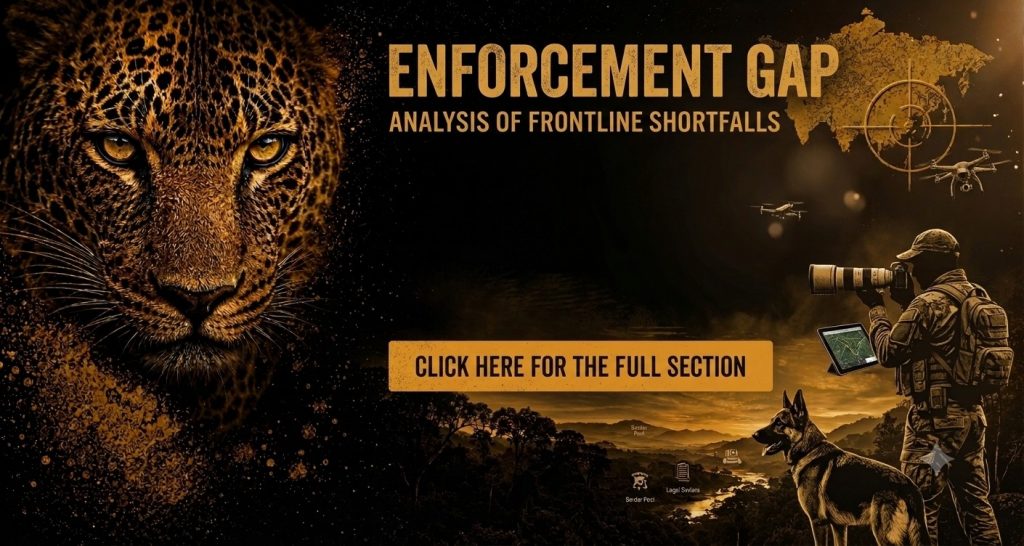
The Enforcement Gap
Lodu Dime: convicted, released on Rs 45,000 bail (~USD 350), no travel ban, absconds. Ramjas Banjara: caught with tiger hide and bones, receives the minimum five-year sentence despite prosecutors seeking the maximum. Nigeria: 63 wildlife shipments intercepted 2010–2021, none resulting in jail time. This is not failure. It is a system operating as designed. Full section coming.06 Global Demand — Multiple Markets
The leopard’s misfortune is the breadth of its markets. Skins to Tibet and China for ceremonial robes. Bones to Chinese TCM manufacturers — 76 licensed companies, 57 products. Claws and teeth to jewellers in India and Europe. Live animals to Gulf state collectors. The diffusion of demand makes supply-side intervention alone insufficient. Included in the enforcement gap issue are loopholes including:
Full Section: The Enforcement Gap
Special Section – The China Loophole — Legal Cover for Illegal Parts
The illegal trade in leopard bone does not survive despite China’s laws. In critical respects, it survives because of them. This is the conclusion of three decades of investigation by EIA, TRAFFIC, and independent researchers — a documented, traceable policy history in which each revision of China’s wildlife regulations has preserved the legal architecture that launders illegally sourced leopard bone into apparently legitimate supply chains.
1993 – China bans tiger bone in TCM — and simultaneously approves leopard bone as a formal substitute. The ban on one species creates state-sanctioned demand for another.
2006 – “Existing stocks only” rule introduced. No information on the scale of those stocks made publicly available. No independent verification mechanism. The opacity is the loophole.
2016 – Wildlife Protection Law revised. A “heritage conservation” provision is inserted permitting large-scale commercial trade in protected species. Permits issued to companies previously implicated in tiger bone wine and tiger skin trade.
2018 – Chinese government approves sale of 1,230.5 kg of leopard bone to a single manufacturer. The product — Hongmao Yaojiu — had been designated “intangible cultural heritage” in 2014. Over one tonne of leopard bone. In a country whose own leopard population is negligible.
2023 – Law revised again. Loophole intact. TCM products containing leopard bone: now at least 57, manufactured by at least 76 licensed Chinese companies. Up from 35 products in 2018. The number nearly doubled during the period CITES was formally calling on China to close these markets.
The supply chain that ends in a licensed Chinese pharmacy begins with a snare on an Indian hillside, a poacher in Nepal, a trafficker in Kathmandu. The legal permit provides the documentation that separates the finished product from its illegal origin. The system does not accidentally accommodate trafficking — its structural opacity makes trafficking functionally necessary to sustain commercial production at current scale.
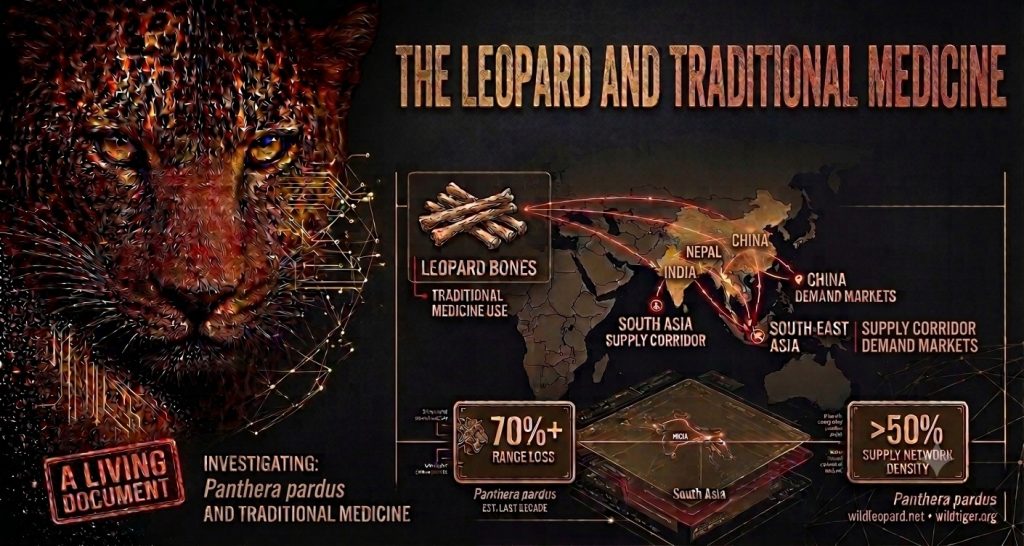
This report focuses on the illegal trade in leopard body parts. Active field research, LeopardEye monitoring deployments, and partnership investigations are underway. The China leopard bone loophole — the legal framework that sanctions leopard bone as a tiger-bone substitute in traditional medicine — is examined in the Global Demand section, and will be expanded further as new intelligence is confirmed during current collaborations. UPDATE: New Section – The Leopard and Traditional Medicine
The leopard is being boiled down to glue. Across Africa and Asia, thousands of these protected big cats are killed each year, their bones reduced to gelatin and sold as traditional medicine—much of it through legal loopholes that render the trade almost invisible. This is not a relic of the past. It is a sophisticated, transnational criminal enterprise operating in plain sight, propped up by legacy drug approvals, captive-breeding fraud, and a regulatory system that has yet to catch up with the forensic evidence. The medicine has a name, a price, and a place on the shelf. The leopard does not. Read the full section HERE.
Habitat Loss – Ongoing Section Updates. Read the initial report HERE.

Recommendations – An Ongoing Dialogue
Addressed to governments, enforcement agencies, CITES parties, and donor organisations.
*Elevate Leopard Trafficking as a Tier-One Enforcement Priority
*Dedicated investigative capacity, prosecution targets, and diplomatic pressure on destination markets must reflect the actual scale of the trade. Leopard must be explicitly included alongside tiger and rhino in INTERPOL operations and CITES enforcement prioritisation.02 Close the China Leopard Bone Loophole
*China’s 2009 provision permitting domestic use of legally sourced big cat skins, combined with the “heritage conservation” loophole of 2016, creates a laundering mechanism for illegally sourced material. CITES parties should formally call on China to rescind these provisions.03 Mandate Standardised Seizure Reporting
*CITES itself has acknowledged it cannot disaggregate Asian leopard seizure data by subspecies or region. A standardised, publicly accessible global database for leopard seizures is the foundational requirement for evidence-based policy.04 Reform Bail and Sentencing in Key Jurisdictions
*Bail conditions must be proportionate to the economic value of wildlife crime and include mandatory travel restrictions. The Lodu Dime case — Rs 45,000 bail after conviction — must become a reference case for judicial reform across range states.
The recommendations section will be published in full with constant updates as solutions are manifested. Key, urgent works on as below require urgent, critical attention:
*Address Snaring at Source — #AntiSnare
The snare is the primary acquisition tool in the leopard supply chain. Anti-snaring programmes must combine patrol and removal with proactive prosecution of snare-setters and genuine livelihood alternatives for communities at the forest edge. Removal alone is demonstrably insufficient.
*Fund Enforcement Staffing in Range States
Odisha’s 58% ranger vacancy rate is structural, not exceptional. Chronic understaffing enables the trade. International conservation funding must prioritise enforcement capacity alongside survey and research — patrol infrastructure is not a secondary concern.
*Recognise the Leopard as a Flagship for Neglected Species
A formal CITES resolution acknowledging the leopard’s disproportionate trade pressure relative to its enforcement priority would create a framework for the wider argument: that the conservation paradigm must expand beyond iconic megafauna to reflect the actual geography of wildlife crime.
This Report Is A Living Document
Blood of the Leopard is published as an initial statement of a problem that demands ongoing documentation. Field work, partner investigations, and new seizure data will be integrated continuously. The China leopard bone section, a market mechanism previously exposed by the Environmental Investigation Agency (EIA) will be updated following further investigations and collaborations. The South Asia Context report will follow the Kathmandu conference referenced below.
If you have information relevant to leopard trafficking — seizure data, case outcomes, intelligence — contact Mission Leopard through wildleopard.net or wildtiger.org.
Blood of the Leopard First published May 2026 by: Mission Leopard an entity of WildTiger. Highlighted at Conservation Asia Congress 2026 in conjunction with the event organizer BCRCF in Kathmandu, Nepal · 3–5 June 2026
