
Blood of the Leopard (BoL) – Living Intelligence Assessement and Blood of the Leopard (BoL) – Overview and Links to Sections.
The Snare Entry Point to the Supply Chain
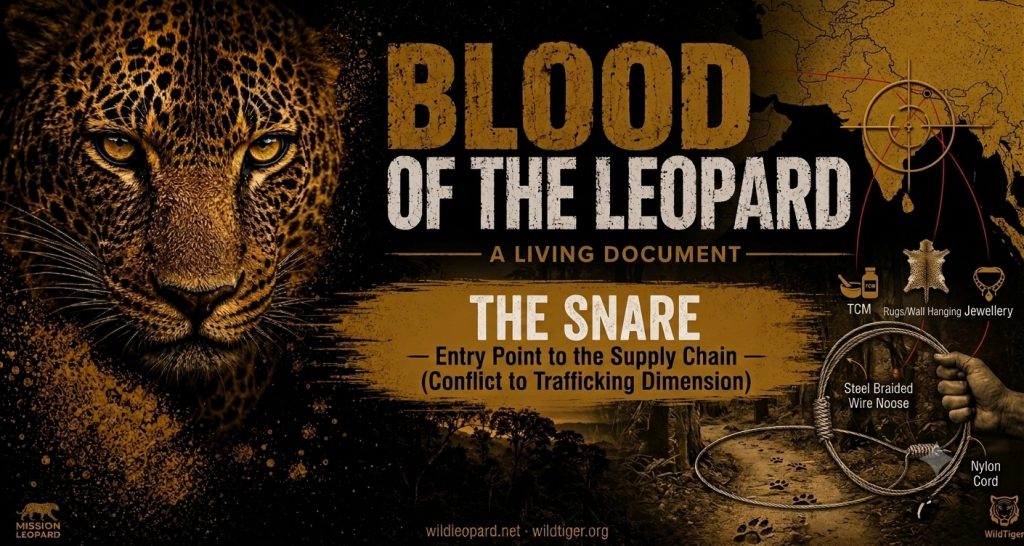
The Wire That Doesn’t Discriminate
The distinction between targeted poaching and opportunistic snaring collapses at the point where the carcass is processed and the parts enter the market.
This is the central truth that connects our initiative #AntiSnare to Blood of the Leopard’s documentation of the trafficking trade. A wire loop set for a barking deer kills a leopard with equal efficiency. A snare set by a subsistence farmer to protect his crops kills a leopard that his community will then skin and sell, because the skin has value and the fine for setting the snare is negligible. A targeted snare set by a professional poaching network kills a leopard whose parts are pre-sold to an aggregator before the animal is even dead. The snare does not distinguish. Neither does the market that follows.
Understanding this connection is essential to understanding why the leopard parts trade is so persistent — and why addressing it requires confronting the full spectrum of the methods by which leopards are killed.
The Scale of the Snaring Crisis
The snare is the most widespread and chronically underreported driver of wildlife death on the planet. The numbers are staggering.
More than 40 million snares are set annually in Central Africa alone. In Southeast Asia, 12.3 million snares threaten wildlife in protected areas of Cambodia, Lao PDR, and Vietnam. More than 700 mammal species are impacted by snares in Southeast Asia according to WWF-TRAFFIC data. For leopards specifically: an analysis of 100 leopard deaths recorded by Sri Lanka’s Department of Wildlife Conservation between 2001 and 2023 revealed that snares are the leading cause of mortality at 77%, followed by poisoning at 8%.
In South Asia, 93% of documented leopard snaring occurs outside protected areas — at the agricultural-forest interface where patrol infrastructure is minimal or absent. In Nepal’s Sudurpaschim Province alone, conservation teams have rescued 28 leopards trapped in snares over the past decade. Officials confirmed that many other leopards escaped from traps before rescue teams arrived, while some died after being caught.
What Happens in a Snare
The Karnataka image that opens this section was taken in February 2025. A leopard had been caught in a trap set near a coffee estate in Balur, Mudigere taluk — originally set for wild boar. While trying to free itself, the snare tightened around the waist of the leopard, leading to its death. The forest department arrived too late.
In Nanjangud, Mysuru district, in the same month, a four-year-old leopardess was caught in a snare laid to poach wild boar on farmland. She was tranquilised and taken to hospital. She did not survive.
A snare is a loop of wire — typically braided steel cable, fencing wire, or nylon cord — anchored to a stake or tree, set at throat or leg height along an animal trail. When a big cat moves through it, the loop tightens. The animal’s immediate response is explosive. The wire, under the full force of a panicked big cat’s bodyweight, cuts through fur and into skin. Each subsequent struggle drives the wire deeper through soft tissue to bone. Infection follows rapidly in tropical temperatures. Dehydration and organ failure compound it. The total duration from capture to death ranges from several hours to three or four days.
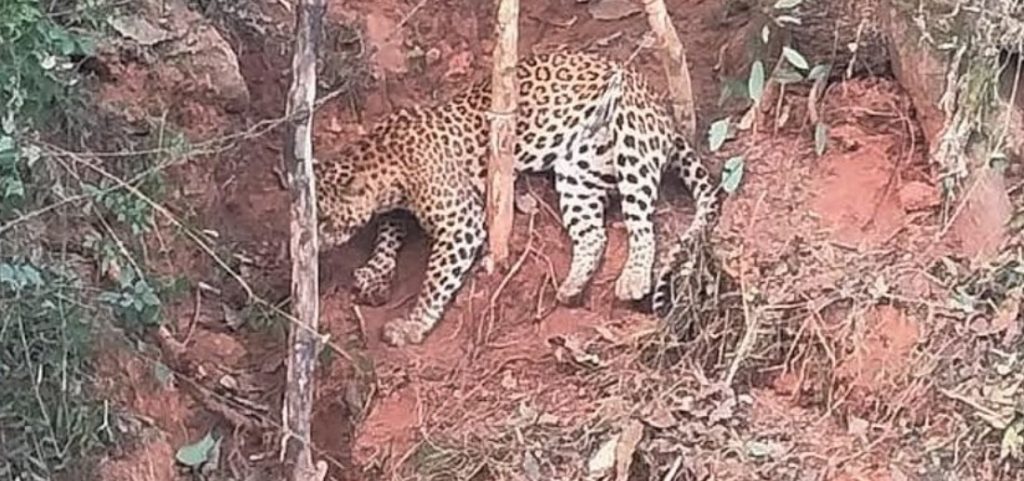
The leopard in the Karnataka image did not die cleanly. No leopard in a snare does.
The Snare as Supply Chain Entry Point
The snare is not a conservation problem separate from the trafficking problem. It is the primary acquisition tool at Tier 1 of the leopard supply chain — the point where a living animal becomes a marketable commodity.
A leopard killed in a snare set for wild boar — bycatch, unintended, unreported — enters the same parts market as a leopard killed by a professional network with a pre-arranged buyer. The skin, the claws, the teeth, the bones: all have value. All move through the same aggregation and distribution system. The cause of death is irrelevant to the market. What matters is the condition of the parts.
The Kandhamal case documented in May 2026 illustrates the mechanism precisely: a farmer poisons a leopard that killed his cow, holds the skin for nearly a year, then attempts to sell it. The retaliatory kill — driven by economic loss — becomes a trafficking event. The farmer is not a professional poacher. He is a person who found that the dead animal had value, in a landscape where enforcement of the sale is negligible and the economic pressure to sell is real.
A skin intercepted in Siliguri, West Bengal in April 2026 — en route to Nepal then China — illustrates where that value goes. From a snare in a Karnataka coffee estate or a Mysuru farmfield to a market in Tibet: the pipeline is short, documented, and operating continuously.
The Full Spectrum — How Leopards Are Being Killed
The snare is the dominant method. It is not the only one. Understanding the full toolkit of leopard poaching is essential to understanding the supply chain that feeds the trafficking network.
Snares and wire traps — the primary method
High-tensile steel wire, set as a strangle loop along animal trails, at throat or leg height. The most widely used, lowest-cost, lowest-risk method for the poacher. Requires no specialist skill or equipment. A snare costs pennies to replace after removal. Documented research on poaching methods in India found snares and traps were the most frequently recorded method across wildlife crime cases studied, alongside electrocution, poisoning, shooting, and spearing. The snare’s dominance reflects its simplicity and its operational invisibility — it kills without the poacher being present. ResearchGate
Poison — the silent method
Poachers in Himachal Pradesh have shifted to poison for killing leopards, throwing poison-laced meat in forest areas. Police in Theog arrested two poachers who had used this method — no gunshot wounds or trap marks on the recovered skin, only forensic testing confirmed poisoning. Poison is attractive to poachers precisely because it leaves the least evidence. A leopard that consumes poisoned bait — typically a livestock carcass laced with carbofuran or endosulfan — dies away from the bait site, making investigation difficult. In Sri Lanka, poisoning accounts for 8% of documented leopard deaths, concentrated in cattle-herding regions in buffer zones of protected areas, where herders use the method against animals that have attacked livestock. The retaliatory poison kill — conflict-driven rather than profit-driven at the point of death — nonetheless produces a carcass whose parts enter the same trade network. SawenWcn
Electrocution — the emerging threat
Electrocution is turning into a preferred method to trap wild animals across India. Experts note that while shooting is risky and poisoning often harms cattle leading to community uproar, electrocution is a silent method that mostly goes undetected. Wildlife trade monitoring experts have stated that “only strong intelligence and active surveillance can stop the rising incidents of electrocution.” Illegal electric fence wires are strung at animal height along known movement corridors — effectively a lethal snare that kills instantly and leaves minimal physical evidence. Two leopards were documented killed by electrocution in one period alongside tigers, elephants, and other species. In Nepal, electrocution has emerged as a documented new threat to wildlife — naked electric wires laid on the ground near settlements, used against rhinos in Chitwan and posing an equivalent threat to leopards moving through the same agricultural-forest interface. EIAWildlife Trust of India
Shooting — targeted and rapid
Gun-based poaching — using licensed firearms, illicitly obtained weapons, or crude country-made pistols — produces the clearest evidence of targeted killing but carries the highest risk for the poacher. WPSI data from India recorded leopards shot dead among documented poaching methods, alongside those killed by traps and poison. In Karnataka in 2023, two men were arrested for shooting a leopard using country-made pistols — the carcass abandoned when they heard someone approaching, the skin left behind. Where snaring and poisoning serve both opportunistic and systematic poaching, shooting typically indicates targeted operation — a specific animal or area identified for take. Discoveryjournals
Mob killing — community retaliation
When a leopard kills livestock or attacks a person, community retaliation can be immediate and collective. Beating, stoning, and mob killing are documented responses across India and Nepal, frequently going unreported and unprosecuted. The leopard killed by a mob after entering a village does not disappear — its parts have value, and in landscapes where the trafficking network operates, a mob killing becomes a supply event within hours. The intersection of conflict, retaliation, and trafficking is documented in our Coexistence Paradox section — the same animal, the same death, feeding two different documented crises simultaneously.
The #AntiSnare Response
WildTiger’s #AntiSnare campaign operates on the understanding that the snaring crisis cannot be addressed through snare removal alone. The response requires three simultaneous elements:
Patrol and removal — systematic, GPS-logged snare sweeps across high-risk areas, building a data picture of snaring intensity and location over time. LeopardEye deployments in the Annapurna region provide real-time alert infrastructure that supports patrol teams in identifying active snaring areas before kills occur. Each snare removed is logged, mapped, and analysed for placement patterns that reveal network activity.
Prosecution — the consistent, documented arrest and prosecution of snare-setters at a level that creates genuine deterrence. Currently, the prosecution rate for snare-setting is negligible across most of the leopard’s range. A snare costs pennies to replace. The legal consequence of setting one, in most jurisdictions, is close to zero. Until the cost of setting a snare — in legal terms, not just in enforcement effort — matches the value of what it kills, the economics favour the poacher.
Livelihood alternatives — the hardest and most important element. The communities at the agricultural-forest interface who set snares do so within an economic logic that conservation intervention cannot simply override. A farmer who has lost a goat worth Rs 8,000 to a leopard, received no compensation, and finds that a leopard skin is worth Rs 50,000 to an aggregator, is operating rationally within the system that exists. Changing that system requires sustained investment, rapid compensation mechanisms, community trust, and political will at a level that conservation funding rarely provides consistently.
Without all three elements operating simultaneously, #AntiSnare is snare removal. And snare removal is not enough.
The Connection — One System
Every method documented in this section — snare, poison, electrocution, shooting, mob kill — produces the same outcome at the point where the trafficking network begins. A dead leopard. Parts with market value. An aggregator with a phone number and a collection point.
The snare is the most common entry point. It is not the only one. Addressing the supply side of the leopard parts trade requires confronting all of these methods simultaneously — not as separate conservation problems but as components of a single criminal economy whose endpoint is a skin on a Tibetan buyer’s table, a claw in a jeweller’s workshop in Guangzhou, a bone in a licensed TCM manufacturer’s production line in China.
The wire in the Karnataka forest and the product on the shelf in the destination market are the same transaction. The snare is where it begins.
Blood of the Leopard is a living document published by WildTiger/Mission Leopard.
