
Blood of the Leopard – The Coexistence Paradox
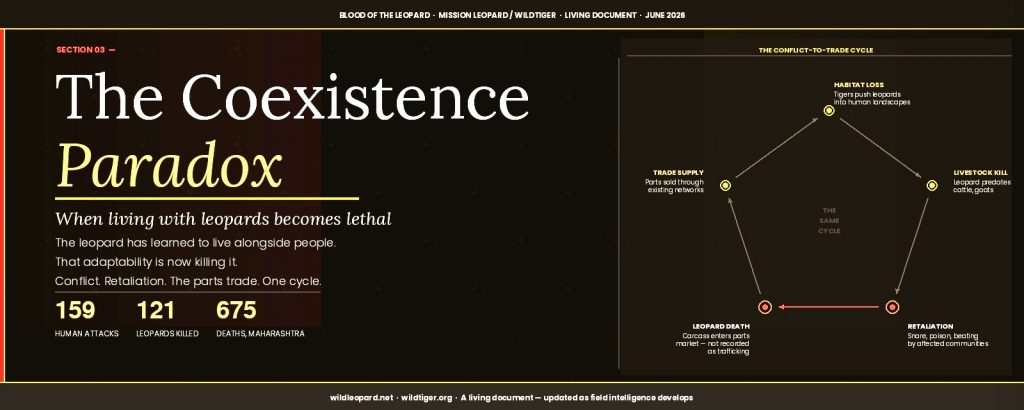
The leopard is the only big cat that has genuinely learned to live alongside human beings. It inhabits sugarcane fields and tea gardens, the edges of megacities and mountain villages, agricultural land and temple forests. No other large predator has demonstrated this degree of ecological flexibility. It is, in every measurable sense, a species adapted for coexistence.
That adaptability is now killing it.
The closer the leopard lives to people, the more frequently it kills livestock. The more frequently it kills livestock, the stronger the economic and emotional pressure on communities to retaliate. The more communities retaliate, the more leopards die — poisoned, snared, beaten, and shot in incidents that are rarely prosecuted, frequently unreported, and systematically undercounted. And critically: the leopard killed in retaliation does not disappear. It enters the same parts market as the leopard killed by a professional poaching network. The conflict and the trafficking trade are not separate problems. They are the same problem, wearing different faces.
The Numbers
In Pauri Garhwal, Uttarakhand, 159 attacks on humans were recorded between 2006 and 2016. 121 leopards were killed in the same period — in retaliation by local communities or declared as man-eaters. Attack and counter-kill, running at near-equal rates across a decade. Society for Conservation Biology
In Baitadi district, mid-hills Nepal, leopards killed 23 people and injured eight between 2011 and 2019. In retaliation, communities killed 26 leopards in the same period. More leopards killed than people — in a district with no commercial poaching network, no trafficking infrastructure, just communities responding to deaths in the only way available to them. Conbio
In Maharashtra, 113 people died from leopard attacks between 2017 and 2022. The situation worsened dramatically: 14 deaths were recorded in just two months in 2025. In the same state, 675 leopard deaths were reported between 2021 and 2026. The political response was to attempt mass translocation — more than 150 leopards captured across three districts in Maharashtra in a two-month period in 2025 — a strategy with a documented history of failure. After a 2001 translocation programme in Junnar, the average annual attack rate rose from 4 to 17. Facebook + 2
The Paradox Made Visible — Junnar, Maharashtra
Junnar was once cited as a model of human-leopard coexistence. It is now India’s most chronic conflict zone. In 2024 alone, eight human fatalities were recorded in ten months. On October 12, 2025, a six-year-old girl was killed in Shirur taluka, Pune district — the third child death in the district that year. In Pimparkhed village, back-to-back fatal attacks within twenty days triggered protests that included the burning of a Maharashtra Forest Department patrol vehicle and a blockade of the Pune-Nashik Highway. Glibs + 2
The state government’s response — announce a plan to transfer 50 leopards to a private facility run under the Ambani family umbrella — generated national controversy and was challenged in court. Maharashtra’s Forest Minister subsequently announced plans to reclassify the leopard from Schedule I to Schedule II of the Wildlife Protection Act — which would remove the highest level of legal protection from a species already under severe trafficking pressure. The political logic is understandable. The conservation consequence would be catastrophic. Facebook
Junnar is not exceptional. It is predictive. What happens when community tolerance for leopards collapses under the weight of repeated deaths, inadequate compensation, and political pressure is visible there in real time. It is a warning about what follows when the coexistence infrastructure — compensation systems, rapid response teams, prey base management, community engagement — is allowed to fail.
The Structural Drivers
The conflict is not random. It follows a logic that field research has now documented clearly across multiple landscapes.
As tiger populations recover in India’s protected forest cores, leopards are displaced into fringe zones, farms, and villages where survival is harder. Easy prey — livestock and waste — turns settlements into ecological traps, increasing attacks on people and animals. The tiger recovery story, rightly celebrated as a conservation success, has a shadow: it pushes leopards into exactly the landscape where conflict is structurally inevitable. Wikipedia
In the Annapurna Conservation Area, Nepal — where Mission Leopard currently operates — 274 cases of leopard attacks on livestock were recorded between 2017 and 2020. Goats were the most frequently predated livestock, followed by sheep, cow/ox, and buffalo. Areas near human settlements and protected area boundaries faced the highest risk. The geography of conflict maps precisely onto the geography of Mission Leopard’s LeopardEye deployments — the agricultural-forest interface where the snare, the retaliation kill, and the trafficking network all converge. mongabay
In North Bengal, leopard attacks on humans have shifted from a seasonal pattern to year-round occurrence. One wildlife professional told researchers: “I try to find areas with no leopards, but it is hard to find such places at present. The animals have spread out to even India’s border areas with Bangladesh, Nepal and Bihar.” The leopard’s range is not contracting. Its conflict footprint is expanding. Society for Conservation Biology
The Trafficking Connection
The link between conflict and trafficking is documented, direct, and consistently underestimated in policy responses to both.
The Kandhamal case documented in May 2026 illustrates the mechanism precisely: a farmer poisons a leopard that killed his cow. He holds the skin for nearly a year, then attempts to sell it. The retaliation kill — driven by economic loss and grief — becomes a trafficking event. The farmer is not a poacher. He is a person who lost livestock he cannot afford to lose, made a decision in anger and desperation, and found that the skin had value. The market did the rest.
This pattern — retaliatory kill entering the parts trade — accounts for a significant and systematically undercounted proportion of leopard supply to trafficking networks. It is not captured in seizure statistics as “trafficking.” It appears as “conflict incident” in forest department records, if it appears at all. The true overlap between conflict mortality and trade supply is unknown, and the data infrastructure to measure it does not currently exist.
What is known is this: the leopard killed in a snare set for a barking deer, the leopard poisoned after a livestock kill, the leopard beaten to death by a mob after entering a village — these animals do not simply die. Their parts have value. And in a landscape where communities bear the costs of living with leopards but receive minimal economic benefit from their conservation, the decision to sell those parts is rational.
The Coexistence Infrastructure — What Works, What Doesn’t
The evidence base on conflict mitigation is now substantial enough to state clearly what reduces conflict and what doesn’t.
Mass translocation does not work. The Junnar data is unambiguous: after translocation, attack rates increased fourfold. Three of the microchipped leopards released in distant protected areas were subsequently recaptured at their new sites after causing casualties in areas with no prior history of human-leopard conflict. Translocation moves the problem, compounds it, and in some cases creates new conflict in previously unaffected communities. Facebook
Predator-proof enclosures, livestock insurance schemes, rapid response systems, and prey base recovery demonstrably reduce conflict where consistently implemented. The challenge is consistent implementation — which requires sustained funding, staffing, and community trust that is difficult to build and easy to destroy with a single fatal attack.
LeopardEye’s early warning system — currently deployed in the Annapurna region — addresses the detection gap: the absence of reliable, real-time intelligence about leopard proximity to settlements and livestock enclosures. A community that knows a leopard is near can take protective action. A community that finds out after a child is killed responds with grief, fear, and frequently, a machete.
The Political Moment
Human-leopard conflict has evolved beyond being an ecological or social issue. It now carries significant political implications. The Maharashtra government’s consideration of downgrading the leopard’s legal protection status is the clearest signal yet that, without a credible and visible coexistence infrastructure, the political economy will eventually turn against the species. When a chief minister’s constituency is burning forest department vehicles and demanding leopard removal, the conservation argument is losing. Glibs
This is the paradox at its sharpest. The leopard’s adaptability — the quality that makes it ecologically extraordinary — generates the conflict that threatens its legal protection, which enables the trafficking that depletes its numbers, which removes the very animals that communities need to learn to live alongside. Each element of the crisis feeds the next.
Addressing the coexistence paradox is not separate from addressing leopard trafficking. It is the same intervention, at a different point in the same cycle.
