
BLOOD OF THE LEOPARD
A Mission Leopard Initiative
ASIA INTELLIGENCE CONTEXT
Understanding the Asian Leopard Trade as One Connected System
October 2026
A Change in Direction
Blood of the Leopard originally approached Asia through separate regional assessments, beginning with South Asia and with Southeast Asia developing as a separate area of study.
As the intelligence picture has developed, however, it has become increasingly clear that this division does not always reflect the way wildlife trafficking operates.
Leopard populations, sources of wildlife products, trafficking networks, transit routes and destination markets do not necessarily conform to regional boundaries.
A leopard killed in one country may enter a supply chain that crosses several others before reaching its intended market.
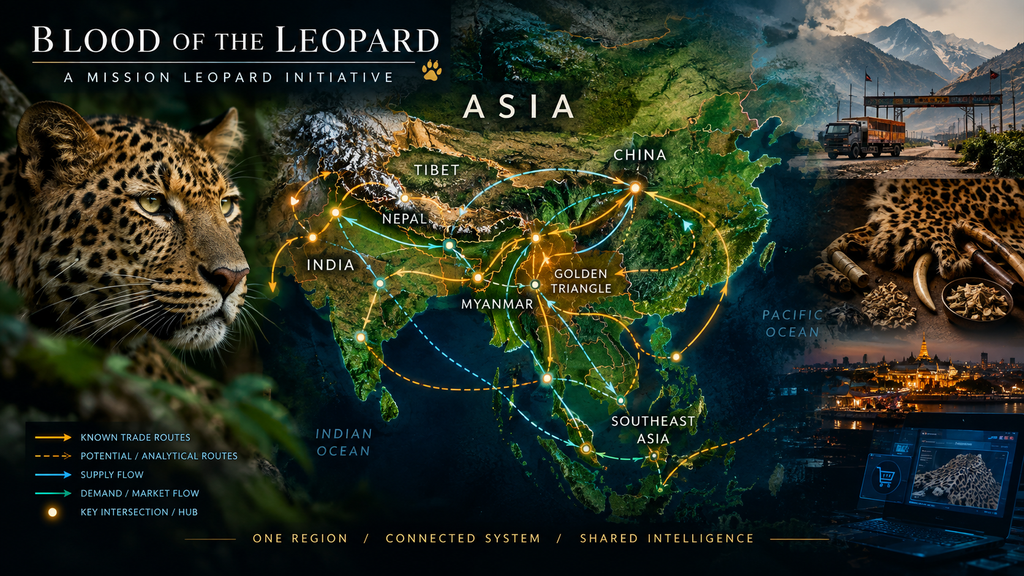
For this reason, Blood of the Leopard is now developing a single Asia Intelligence Assessment, bringing South and Southeast Asia together within one regional intelligence framework.
This does not mean that individual countries or sub-regions become less important.
It means that we can examine them as components of a wider system.
Why Asia?
Asia contains the world’s most extensive and interconnected leopard range and encompasses some of the most significant known markets, trafficking corridors and demand centres for leopard body parts.
The region also contains major differences in:
- leopard populations and habitat;
- wildlife-protection legislation;
- enforcement capacity;
- border controls;
- traditional medicine markets;
- cultural and ceremonial demand;
- organised crime;
- political and economic conditions;
- and access to wildlife products.
These differences can create opportunities for trafficking networks to move wildlife between jurisdictions.
The intelligence challenge is therefore not simply to identify where leopards are being killed.
It is to understand what happens after the killing.
From Source to Market
Blood of the Leopard is developing the Asian assessment around the complete potential supply chain:
LEOPARD MORTALITY
↓
LOCAL COLLECTION / PROCESSING
↓
AGGREGATION
↓
REGIONAL TRAFFICKING
↓
TRANSIT / CONVERGENCE HUBS
↓
DESTINATION MARKETS
At each stage, the people, geography, infrastructure and criminal relationships may change.
The leopard does not.
The body part may, however, travel far beyond the landscape in which the animal died.
Understanding that movement is central to Blood of the Leopard’s intelligence approach.
The Asian Trafficking Landscape
The emerging Asian picture includes several interconnected intelligence environments.
South Asia
India currently provides much of the publicly documented evidence of leopard poaching and trafficking in Asia, including repeated seizures of skins and other body parts.
Nepal provides an important Himalayan and trans-Himalayan interface, while the relationship between Indian source areas, Nepal and Tibet/China requires continued investigation.
The Himalayan and Trans-Himalayan Corridor
The Himalaya should not be viewed simply as a geographical barrier.
For wildlife trafficking, borders, mountain passes, transport routes and established trading relationships can create both obstacles and opportunities.
The India–Nepal–Tibet/China interface is therefore an important area of continuing intelligence development.
Southeast Asia
Southeast Asia contains some of the world’s most threatened leopard populations and some of the region’s most significant wildlife-trafficking pressures.
The Indochinese leopard, in particular, is being examined through Blood of the Leopard’s work on habitat loss, prey depletion, snares and the wider wildlife trade.
Myanmar and the Golden Triangle
The Myanmar–Golden Triangle region requires particular attention.
It occupies a strategically important position between South Asia, Southeast Asia and China and has long been associated with complex transnational trafficking networks involving multiple forms of illicit trade.
For Blood of the Leopard, its significance is not simply that wildlife products may pass through the region.
It is that the area may function as a convergence and redistribution zone, potentially connecting supply from different parts of Asia with different destination markets.
This makes Myanmar and the Golden Triangle a critical intelligence focus within the wider Asian assessment.
Following the Network Rather Than the Map
A conventional regional report might separate:
South Asia
from
Southeast Asia.
Blood of the Leopard will increasingly examine the connections between them.
For example:
India
→
Northeast India / Eastern Corridor
→
Myanmar
→
Golden Triangle
→
China / Southeast Asian markets
is not presented here as an established single trafficking route.
Rather, it represents the type of regional relationship that requires investigation.
Individual cases will determine which connections can ultimately be demonstrated.
This distinction is fundamental.
Blood of the Leopard will not convert geographical proximity, intelligence rumours or analytical possibilities into established trafficking routes.
Evidence Before Assumption
The Asian assessment will distinguish between four levels of intelligence:
DOCUMENTED
Evidence supported by reliable records, enforcement actions, court documents, scientific research or other authoritative sources.
REPORTED
Information published by credible sources but not independently established by Blood of the Leopard.
INTELLIGENCE LEAD
Information that may indicate a significant connection but requires further verification.
ASSESSMENT
An analytical conclusion based upon the available evidence.
These categories will remain distinct throughout the assessment.
An arrest is not a conviction.
A seizure does not necessarily identify the source of an animal.
A suspected route is not an established route.
And the absence of a seizure does not necessarily mean that trafficking is absent.
The Four-Tier Supply Chain
Blood of the Leopard will continue to examine the Asian trade through four broad levels:
TIER 1 — KILLERS / POACHERS
Individuals who kill or obtain leopards.
This may include deliberate commercial poaching, trapping, poisoning and animals killed through human–wildlife conflict whose bodies subsequently enter trade.
TIER 2 — LOCAL AGGREGATORS
Individuals who collect wildlife products from multiple sources and move them toward larger markets.
TIER 3 — REGIONAL TRAFFICKERS
Intermediaries and organised networks capable of moving wildlife products across districts, provinces and international borders.
TIER 4 — DESTINATION BUYERS / MARKETS
Those purchasing, commissioning or ultimately consuming wildlife products.
The structure is deliberately simplified.
Actual networks may contain many more layers.
The purpose is to provide an analytical framework through which individual cases can be compared.
More Than Leopard Poaching
The Asian leopard trade cannot be examined in isolation.
Blood of the Leopard will therefore investigate its relationship with:
- other wildlife trafficking;
- illegal meat and bushmeat networks;
- narcotics;
- human trafficking;
- weapons;
- corruption;
- organised crime;
- digital marketplaces;
- and other forms of illicit commerce.
This is particularly important in regions where criminal networks already operate across multiple commodities.
A leopard skin may represent only one commodity moving through a much larger system.
The Snare
The snare is also central to the Asian assessment.
Snares do more than kill individual animals.
At sufficient scale, they can alter wildlife populations, remove prey, damage ecosystems and create a persistent supply of illegally obtained wildlife.
Blood of the Leopard is therefore examining the snare not simply as a conservation problem, but as a potential entry point into the wildlife-trafficking supply chain.
This will be particularly important in Southeast Asia, where snaring has become one of the defining threats to remaining wildlife populations.
The same question must also be asked elsewhere in Asia:
How many animals killed by indiscriminate trapping subsequently become commodities within wildlife-trafficking networks?
Conflict and Commercial Supply
Human–leopard conflict creates another potential intersection.
A leopard killed because it is perceived as a threat may subsequently become a source of commercial wildlife products.
The motivation for the killing and the motivation for the later trafficking are not necessarily the same.
This distinction is important.
A conflict killing can therefore become incorporated into a commercial supply chain after the animal is dead.
Understanding this intersection will be an important component of the Asian assessment.
Demand
Supply cannot be understood without examining demand.
The Asian assessment will therefore examine markets and motivations for leopard products including:
- skins;
- bones;
- claws;
- teeth;
- other body parts;
- traditional medicine;
- ceremonial use;
- status and prestige;
- and emerging digital markets.
Demand may originate in one location while the animal is killed thousands of kilometres away.
The distance between source and consumer is therefore itself an intelligence question.
Why Myanmar and the Golden Triangle Matter
The Myanmar–Golden Triangle region deserves particular attention because it may connect multiple trafficking environments.
Wildlife products potentially arriving from:
South Asia
and
Southeast Asia
may encounter established networks operating through a region that also connects to:
China
and wider Asian markets.
This makes the region strategically important even where individual trafficking routes remain unproven.
Blood of the Leopard will therefore examine:
- known wildlife-trafficking routes;
- documented seizures;
- border and transit points;
- organised-crime connections;
- online and physical markets;
- links with other illicit commodities;
- and evidence of leopard products moving through the region.
The objective is not to label the entire region as a trafficking route.
It is to determine where the evidence demonstrates convergence.
Building the Asian Intelligence Picture
The Asian assessment will progressively bring together:
CASE STUDIES
↓
SEIZURE DATA
↓
LEOPARD MORTALITY
↓
TRAFFICKING ROUTES
↓
CRIMINAL NETWORKS
↓
DEMAND
↓
ENFORCEMENT RESPONSE
↓
INTELLIGENCE GAPS
The result will be a continually developing regional assessment rather than a static report.
Individual cases may change the wider assessment.
New forensic evidence may alter the understanding of a trafficking route.
A new seizure may reveal a previously unknown intermediary.
An enforcement investigation may expose a connection between apparently unrelated cases.
The intelligence picture therefore remains open.
What We Know — and What We Do Not
There is already substantial evidence of illegal leopard exploitation across Asia.
What remains much less clear is the full architecture connecting:
the leopard killed
to
the person who ultimately profits.
This is one of the central intelligence gaps that Blood of the Leopard seeks to address.
The objective is not to claim knowledge where evidence is absent.
It is to identify the gaps, follow the evidence and progressively reduce uncertainty.
From South Asia to Asia
The previous South Asia Context represented the first stage of this work.
It remains an important evidence base.
The development of the wider Asian assessment does not replace that work.
Instead, it places it within a larger regional framework.
The evidence emerging from India, Nepal and the Himalayan region can now be examined alongside the developing picture from Southeast Asia and the critical Myanmar–Golden Triangle interface.
This allows Blood of the Leopard to follow the system rather than the administrative boundary.
The Next Stage
The Asia Intelligence Assessment is now under development.
It will progressively incorporate the existing Blood of the Leopard case studies and intelligence work, together with new evidence as it becomes available.
The first priority areas will include:
India
Nepal and the Himalayan corridor
Eastern and Northeast India
Myanmar and the Golden Triangle
Indochina
China and wider Asian demand
Cross-border trafficking networks
Crime convergence
The snare and wildlife supply
Digital wildlife trade
The assessment will expand as the evidence allows.
Blood of the Leopard
Observe → Understand → Decide → ACTION
The purpose of intelligence is not simply to describe what has already happened.
It is to understand what may happen next.
The Asian leopard trade is not a collection of isolated national problems.
It is a regional system that must be understood as a system.
Assessment Status: DEVELOPMENT / ACTIVE
October 2026
Blood of the Leopard is Mission Leopard’s living intelligence publication.
